N-Type TOPCon Solar Cell Manufacturer in India
High-Efficiency N-Type TOPCon Solar Cells Manufactured in Gujarat, India
Involt Energy Pvt. Ltd. is an Indian manufacturer of N-Type TOPCon solar cells, with an automated solar cell manufacturing facility at Mitana, near Rajkot, Gujarat. Involt’s stated manufacturing capacity is 1.78 GW, with its product focus centered on N-Type TOPCon solar cell technology.
What Is an N-Type TOPCon Solar Cell?
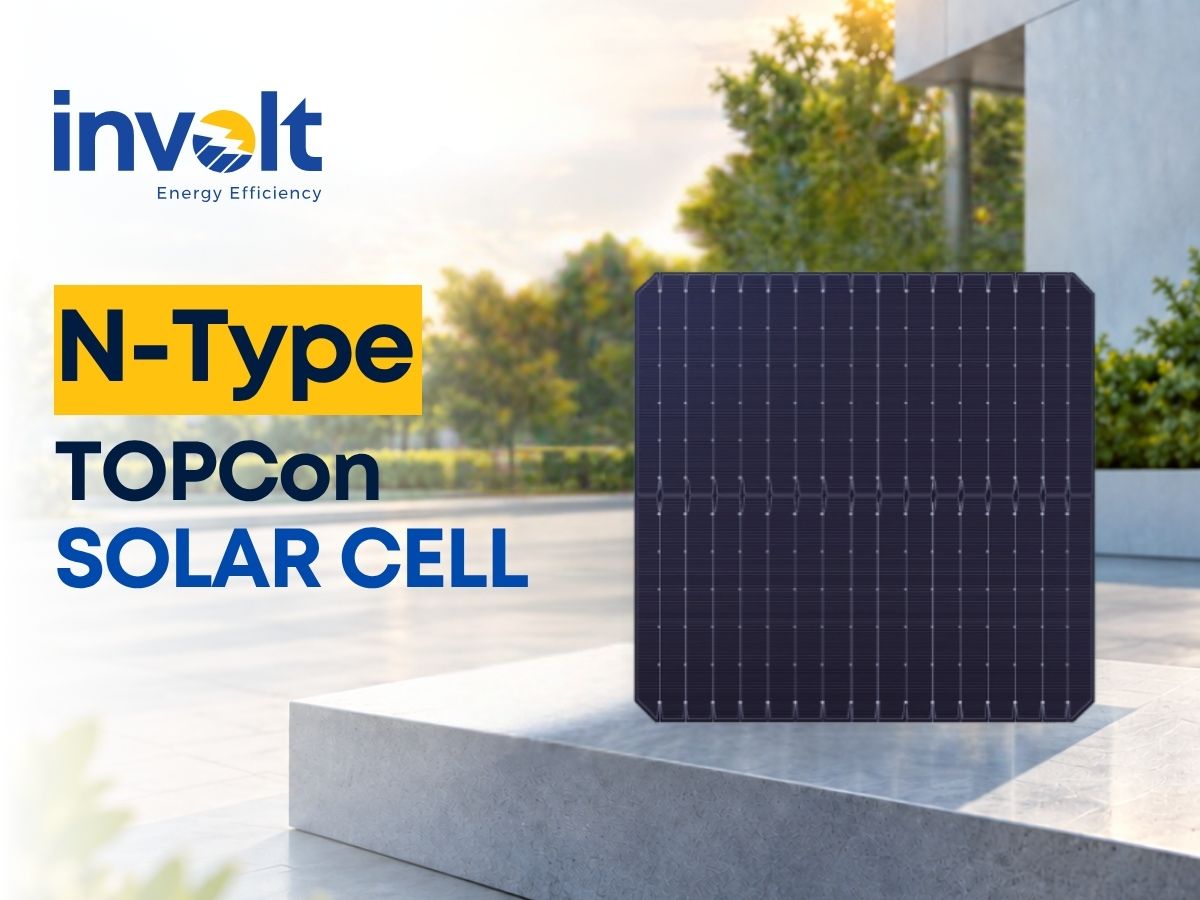
An N-Type TOPCon solar cell is a photovoltaic cell that combines an N-Type silicon base with Tunnel Oxide Passivated Contact (TOPCon) technology. TOPCon uses a thin tunnel-oxide layer and a passivated contact structure designed to reduce charge-carrier recombination at the contact interface.
N-Type refers to the conductivity type of the silicon base material. TOPCon, meanwhile, describes the passivated-contact architecture used in the solar cell. These terms therefore describe different but related aspects of the cell.
How Does N-Type TOPCon Solar Cell Technology Work?
TOPCon technology is designed to improve the contact interface inside a crystalline-silicon solar cell. Its passivated-contact architecture helps charge carriers move through the required contact while limiting recombination that would otherwise reduce electrical output.
1. N-Type Silicon Base
The silicon base is doped to produce N-Type material. The base material forms a fundamental part of the cell’s electrical structure.
2. Tunnel Oxide
A very thin oxide layer is introduced at the passivated contact. The layer contributes to surface passivation while allowing carrier transport through the contact structure.
3. Passivated Contact
The contact architecture is engineered to support selective carrier transport and suppress unwanted recombination at the interface.
Why Is N-Type Silicon Used for TOPCon Solar Cells?
N-Type silicon uses donor doping, commonly associated with phosphorus in crystalline-silicon photovoltaics. Its material characteristics make it well suited to several high-performance cell architectures, including TOPCon.
When assessing an N-Type solar cell, however, buyers should consider the complete cell design and measured specifications rather than judging performance from wafer conductivity type alone. Cell architecture, passivation, contacts, processing quality and electrical consistency all influence final cell characteristics.
N-Type TOPCon Solar Cell Performance Parameters
Technical specifications help buyers evaluate a solar cell beyond its technology name. The following parameters describe important aspects of solar-cell conversion, rear-side response, temperature behaviour, low-irradiance behaviour and degradation resistance.
| Parameter | Involt Specification* | What It Means |
|---|---|---|
| Front-Side Efficiency | ≥25.3% | The proportion of incident solar energy converted into electrical energy under the applicable measurement conditions. |
| Bifacial Efficiency | ≥80% | Indicates the relationship between rear-side and front-side cell response under the applicable test conditions. |
| Power Temperature Coefficient | −0.30%/K | Describes the relative change in cell power as temperature changes from the reference condition. |
| Low-Light Performance | >97% at 200 W/m² | Describes relative cell performance under lower irradiance compared with the applicable reference conditions. |
| LID | 0 | Stated Light-Induced Degradation characteristic. |
| PID | Anti-PID | Stated resistance characteristic relating to Potential-Induced Degradation. |
| Encapsulation Loss | Low Encapsulation Loss | Refers to limiting cell-to-encapsulated performance loss during downstream integration. |
What Does Solar Cell Efficiency Mean?
Solar cell efficiency is the percentage of incident solar energy that an individual photovoltaic cell converts into electrical energy under defined test conditions. It is a cell-level measurement and should not be confused with the efficiency of a finished photovoltaic module.
What Is Bifaciality in a Solar Cell?
Bifaciality describes a solar cell’s rear-side electrical response relative to its front-side response under defined measurement conditions. It is commonly expressed as a ratio or percentage. When comparing bifacial cells, buyers should confirm the exact measurement basis used in the manufacturer’s technical documentation.
What Does Temperature Coefficient Mean for a Solar Cell?
The power temperature coefficient indicates how the electrical power of a solar cell changes as cell temperature changes relative to a reference temperature. A value expressed in %/K describes the percentage change in power for each kelvin of temperature difference under the specified conditions.
What Is LID in Solar Cells?
LID stands for Light-Induced Degradation. It describes an initial change in photovoltaic performance associated with exposure to light. The mechanism and magnitude depend on the silicon material, cell architecture and manufacturing process.
For procurement, LID characteristics should be evaluated using the manufacturer’s current technical specification and the applicable test methodology.
What Is PID in Solar Cells?
PID stands for Potential-Induced Degradation. It refers to performance degradation associated with electrical potential differences and related leakage mechanisms under certain operating and environmental conditions.
An Anti-PID specification should be interpreted according to the manufacturer’s testing conditions and relevant standards.
How Do Solar Cells Perform in Low-Light Conditions?
Solar-cell behaviour changes as irradiance decreases. Low-light performance describes how effectively a cell maintains its relative conversion characteristics under irradiance levels below standard reference conditions.
200 W/m² represents substantially lower irradiance than the 1000 W/m² level commonly associated with Standard Test Conditions for photovoltaic measurements.
Where Involt states low-light performance of >97% at 200 W/m², buyers should refer to the latest technical datasheet for the exact definition, normalization method and test conditions associated with that value.
What Is Encapsulation Loss in Solar Cells?
Encapsulation loss describes the reduction in cell performance that can occur when an individual solar cell is integrated and encapsulated during downstream photovoltaic manufacturing. Optical, electrical and interconnection factors can influence the difference between the cell’s standalone performance and its performance after integration.
For procurement decisions, encapsulation-loss claims should be assessed using the cell manufacturer’s specified methodology and relevant downstream process conditions.
N-Type vs P-Type Solar Cells: What Is the Difference?
The fundamental distinction between N-Type and P-Type crystalline-silicon solar cells begins with the conductivity type of the silicon base. The complete performance of a finished cell, however, also depends on its architecture, passivation, contacts and manufacturing process.
| Aspect | N-Type Solar Cell | P-Type Solar Cell |
|---|---|---|
| Silicon Base | N-Type semiconductor base | P-Type semiconductor base |
| Doping Context | Donor-doped base, commonly phosphorus | Acceptor-doped base, commonly boron |
| Majority Carriers | Electrons | Holes |
| Technology Use | Used with architectures including TOPCon and other advanced cell concepts | Historically widespread across conventional crystalline-silicon cell architectures including PERC |
| Evaluation | Actual cell performance should be compared using measured specifications rather than conductivity type alone. | |
TOPCon vs PERC Solar Cells: How Do the Technologies Differ?
TOPCon and PERC describe different crystalline-silicon solar-cell architectures. A key distinction is the contact/passivation approach used to control recombination and collect charge carriers.
| Aspect | TOPCon | PERC |
|---|---|---|
| Full Name | Tunnel Oxide Passivated Contact | Passivated Emitter and Rear Cell |
| Architecture | Uses a tunnel oxide and passivated-contact structure | Uses rear-side passivation with localized contacting |
| Contact Strategy | Carrier-selective/passivated contact is central to the architecture | Localized rear contacts through a passivation layer are characteristic of conventional PERC architecture |
| Procurement Approach | Compare actual efficiency, electrical parameters, degradation characteristics, consistency and manufacturer test data rather than selecting by technology name alone. | |
How Are N-Type TOPCon Solar Cells Manufactured?
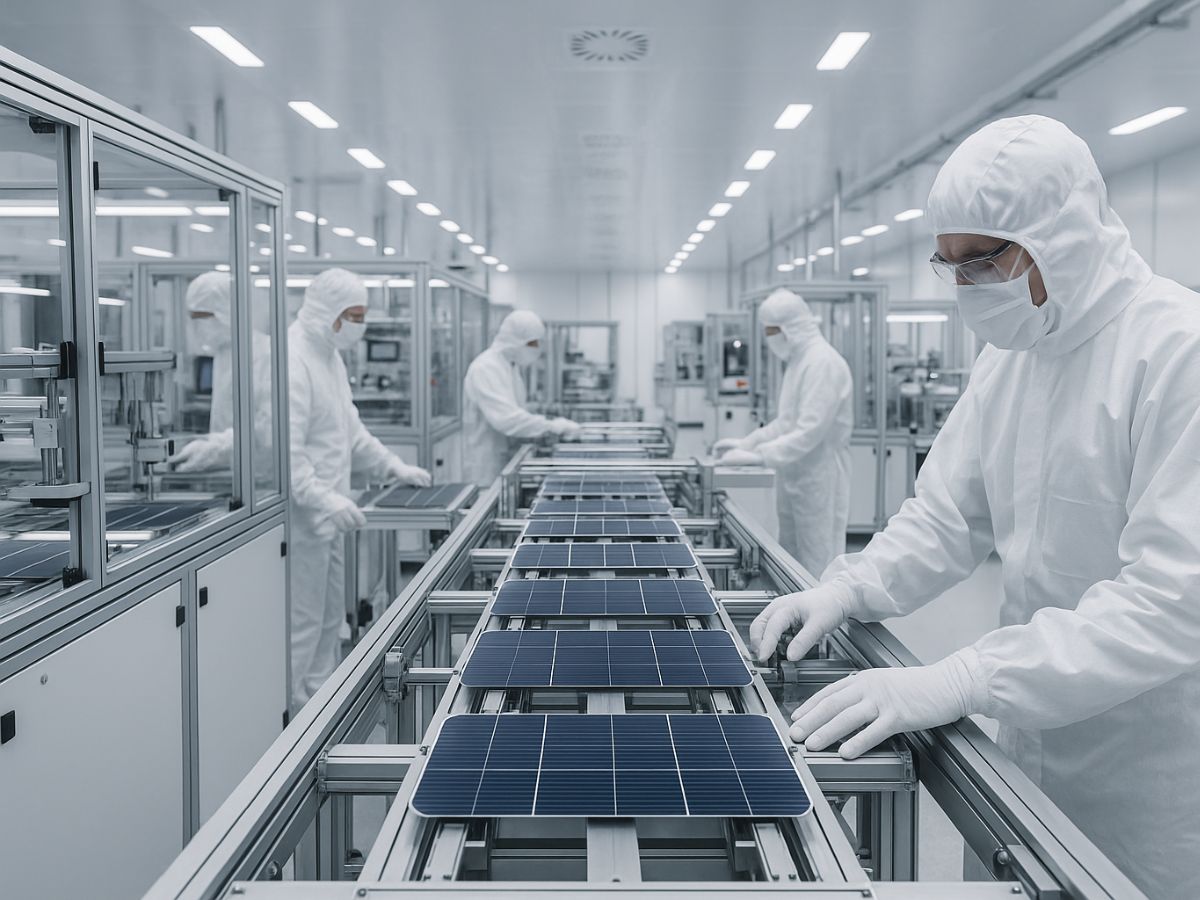
TOPCon solar-cell manufacturing begins with crystalline-silicon wafers and involves a sequence of surface preparation, junction formation, passivation, contact formation, metallization and electrical characterization processes. Exact process flows vary between manufacturers and production technologies.
For TOPCon architecture specifically, formation of the tunnel-oxide/passivated-contact system is a key part of the process. Process control is important because surface quality, passivation, contact formation and metallization can influence electrical characteristics and production consistency.
How Are N-Type TOPCon Solar Cells Manufactured?
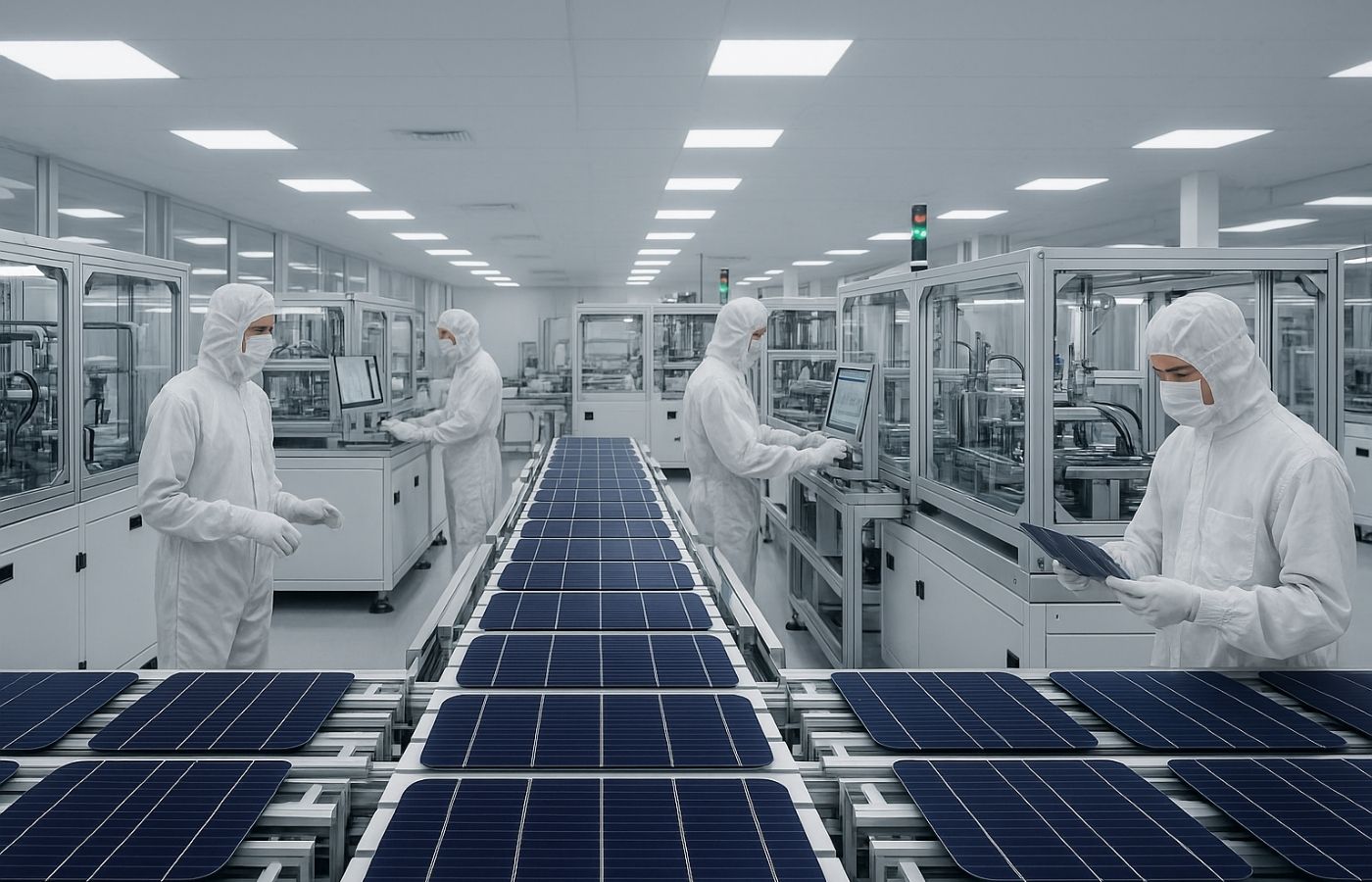
Explore the key stages behind N-Type TOPCon solar cell production, from wafer texturing and passivation through metallization, electrical testing, sorting and automatic packing.
Quality Control in Solar Cell Manufacturing
Solar-cell quality control is intended to verify that manufactured cells meet defined electrical, physical and consistency requirements. Depending on the manufacturer and product, evaluation can include electrical characterization, visual inspection, efficiency classification and other process or reliability checks.
Electrical Characteristics
Electrical measurements help characterize the cell’s current-voltage behaviour and resulting performance parameters under defined test conditions.
Cell Consistency
For B2B procurement, buyers should evaluate consistency across supplied cells in addition to headline efficiency values.
Traceability & Documentation
Technical documentation, classification information and applicable quality records help buyers evaluate supplied solar cells against procurement requirements.
What Should Buyers Check When Sourcing N-Type TOPCon Solar Cells?
Solar-cell procurement should consider more than the maximum efficiency figure. Buyers should evaluate whether the electrical, physical and reliability characteristics of the cell match their production and product requirements.
Buyers comparing the wider Indian manufacturing landscape can also explore our guide to TOPCon solar cell manufacturers in India , covering identified cell-manufacturing activity, technology platforms, manufacturing locations and the technical factors B2B buyers should compare before shortlisting a source.
- Verified cell efficiency and efficiency distribution
- Cell dimensions and physical specifications
- Electrical parameters and tolerances
- Bifaciality specifications where applicable
- Power temperature coefficient
- Low-irradiance behaviour
- LID and degradation characteristics
- PID-related characteristics and test basis
- Cell consistency across production batches
- Technical documentation and test conditions
- Quality assurance and traceability information
- Packaging, handling and supply requirements
For module production requirements, explore our N-Type TOPCon solar cells for module manufacturers in India for G12R specifications, module compatibility, quality assurance and B2B sourcing considerations.
ALMM List-II for Solar PV Cells: What Should Buyers Check?
For procurement requirements where ALMM provisions are relevant, module manufacturers and B2B buyers should check the latest official ALMM List-II for solar PV cells alongside their technical supplier evaluation.
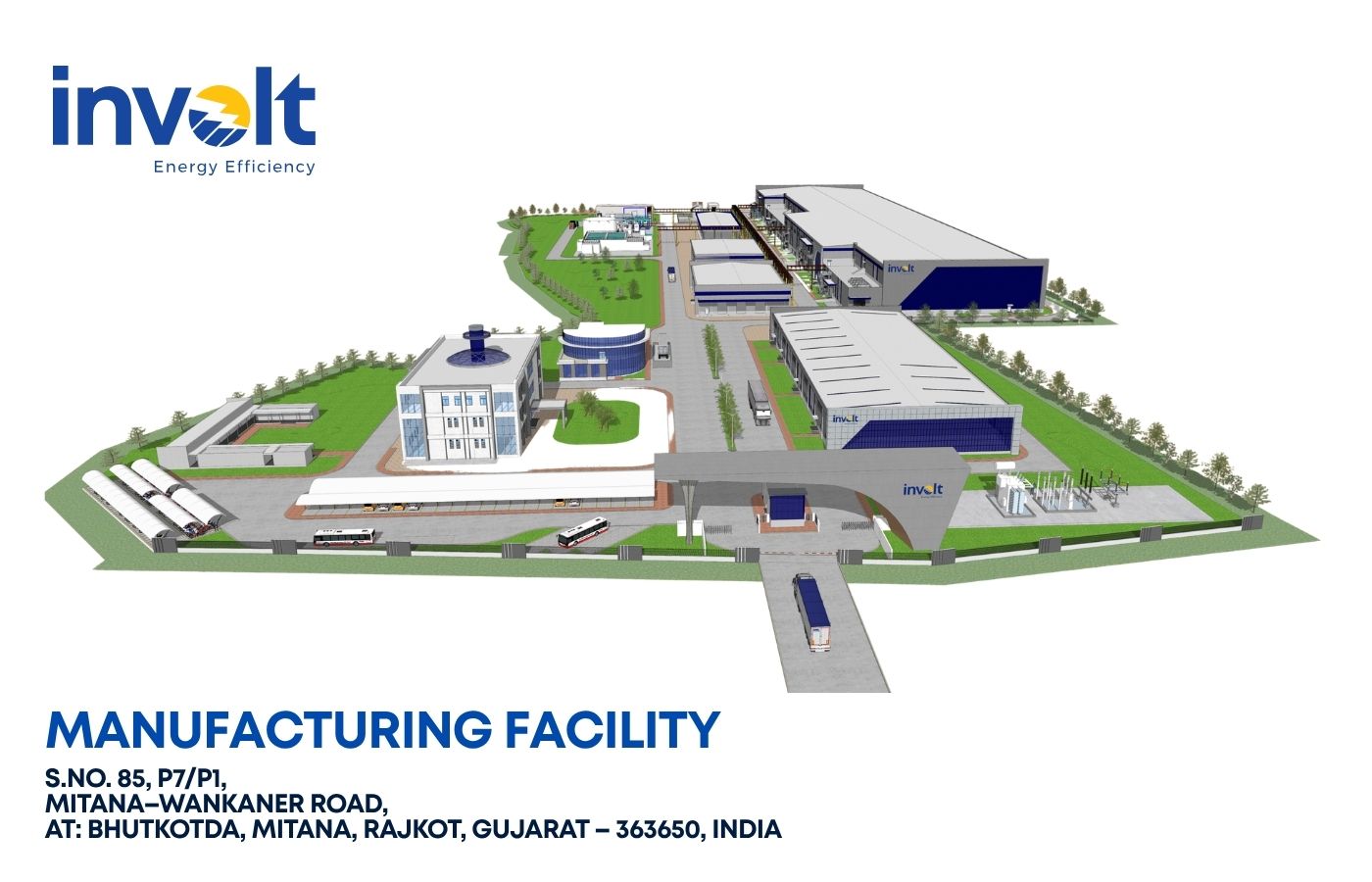
N-Type TOPCon Solar Cell Manufacturing in Gujarat, India
Involt Energy’s solar-cell manufacturing facility is located at Mitana, near Rajkot in Gujarat, India. The company focuses on N-Type TOPCon solar cell manufacturing and states an automated manufacturing capacity of 1.78 GW. Buyers looking specifically for a Gujarat-based manufacturing source can explore Involt Energy as an N-Type TOPCon solar cell manufacturer in Gujarat, including details on its G12R 16BB cell platform, manufacturing capabilities, quality controls and B2B supply.
For buyers evaluating an Indian N-Type TOPCon solar cell manufacturer, the relevant assessment should combine manufacturing capability with verified cell specifications, product consistency, quality documentation, technical support and supply requirements.
About Involt Energy’s N-Type TOPCon Solar Cell Manufacturing
Involt Energy Pvt. Ltd. is focused on solar-cell manufacturing using N-Type TOPCon technology. Its manufacturing facility is located at Mitana, near Rajkot, Gujarat, with a stated automated manufacturing capacity of 1.78 GW.
N-Type TOPCon Focus
Involt’s product positioning is centered on N-Type TOPCon solar-cell technology.
Manufacturing in India
Solar cells are manufactured at Involt’s facility in Mitana, near Rajkot, Gujarat.
Technical Specifications
Buyers can evaluate Involt cells using documented parameters including efficiency, bifaciality, temperature behaviour and other applicable cell characteristics.
Evaluating TOPCon Against PERC Technology?
Explore how TOPCon and PERC solar cells differ in cell architecture, substrate considerations, LID, bifaciality, temperature behaviour and manufacturing.
N-Type TOPCon Solar Cell FAQs
What is an N-Type TOPCon solar cell?
An N-Type TOPCon solar cell combines an N-Type silicon base with Tunnel Oxide Passivated Contact technology. The TOPCon architecture uses a thin tunnel-oxide layer and passivated contact designed to reduce carrier recombination at the contact interface while enabling selective charge-carrier transport.
What does TOPCon stand for?
TOPCon stands for Tunnel Oxide Passivated Contact. It is a crystalline-silicon solar-cell architecture characterized by a thin tunnel oxide and a passivated contact structure designed to improve contact passivation and carrier selectivity.
How does TOPCon solar cell technology work?
TOPCon technology uses a thin oxide layer together with a passivated contact. This structure is designed to reduce unwanted carrier recombination at the contact interface while allowing useful charge carriers to be collected, supporting efficient conversion within the solar cell.
What is the difference between N-Type and P-Type solar cells?
The primary difference is the conductivity type of the silicon base. N-Type silicon uses donor doping and has electrons as majority carriers, while P-Type silicon uses acceptor doping and has holes as majority carriers. Actual solar-cell performance also depends on architecture, passivation, contacts and manufacturing quality.
What is the difference between TOPCon and PERC solar cells?
TOPCon and PERC use different passivation and contact architectures. TOPCon incorporates a tunnel-oxide/passivated-contact structure, whereas conventional PERC uses rear-side passivation with localized contacts. Buyers should compare measured cell specifications rather than relying on the technology name alone.
What is solar cell efficiency?
Solar cell efficiency is the percentage of incident solar energy converted into electrical energy by an individual photovoltaic cell under defined test conditions. Cell efficiency is a cell-level measurement and should not be confused with the efficiency of a complete photovoltaic module.
What is bifaciality in solar cells?
Bifaciality describes a solar cell’s rear-side electrical response relative to its front-side response under specified test conditions. It is generally expressed as a ratio or percentage and should be interpreted using the measurement conditions provided by the cell manufacturer.
What is LID in solar cells?
LID means Light-Induced Degradation. It describes an initial performance change that can occur when a photovoltaic cell is exposed to light. The mechanism and magnitude depend on silicon material, cell architecture and manufacturing processes.
What is PID in solar cells?
PID means Potential-Induced Degradation. It refers to photovoltaic performance degradation associated with electrical potential differences and related leakage mechanisms under certain environmental and operating conditions. PID characteristics should be assessed against the applicable test method.
What is the temperature coefficient of a solar cell?
A solar cell’s power temperature coefficient describes the relative change in electrical power as cell temperature changes from a reference condition. It is commonly expressed as a percentage per kelvin (%/K), with the manufacturer’s datasheet defining the applicable measurement basis.
How do TOPCon solar cells perform under low irradiance?
Solar-cell electrical behaviour changes as irradiance decreases. Low-irradiance performance indicates how effectively a cell maintains its relative conversion characteristics below standard reference irradiance. Comparisons should use manufacturer data measured and normalized under clearly defined test conditions.
How are N-Type TOPCon solar cells manufactured?
TOPCon cell production generally includes silicon-wafer preparation, junction formation, surface passivation, formation of the tunnel-oxide/passivated-contact system, metallization and electrical characterization. Exact production sequences and equipment differ between manufacturers.
What should buyers check when sourcing TOPCon solar cells?
Buyers should evaluate verified efficiency, electrical parameters, cell dimensions, consistency, bifaciality where relevant, temperature coefficient, degradation characteristics, low-irradiance behaviour, technical documentation, quality assurance, traceability and supply requirements.
Where are Involt Energy solar cells manufactured?
Involt Energy manufactures N-Type TOPCon solar cells at its facility in Mitana, near Rajkot, Gujarat, India. The company states an automated solar-cell manufacturing capacity of 1.78 GW.
How can buyers request Involt N-Type TOPCon solar cell specifications?
Buyers can contact Involt Energy directly to request the current N-Type TOPCon solar cell datasheet, available specifications, technical documentation and information relevant to their solar-cell procurement requirements.
How Should Buyers Evaluate a TOPCon Solar Cell Manufacturer?
Explore the key factors module manufacturers and procurement teams should review, including solar cell specifications, manufacturing capability, quality control, testing, traceability and technical documentation.
Review TOPCon Solar Cell Specifications
Evaluating N-Type TOPCon solar cells for module manufacturing? Review the key electrical, dimensional, metallization, testing and module-compatibility parameters B2B buyers should consider.
Explore TOPCon Solar Cell Specifications →Request Involt N-Type TOPCon Solar Cell Specifications
For current solar-cell specifications, technical documentation and B2B supply enquiries, contact Involt Energy to discuss your N-Type TOPCon solar cell requirements.
Request Solar Cell Information