High-Efficiency Solar Cell Manufacturing in India: Why N-Type TOPCon Is Leading the Next Generation – Involt Energy Pvt. Ltd.
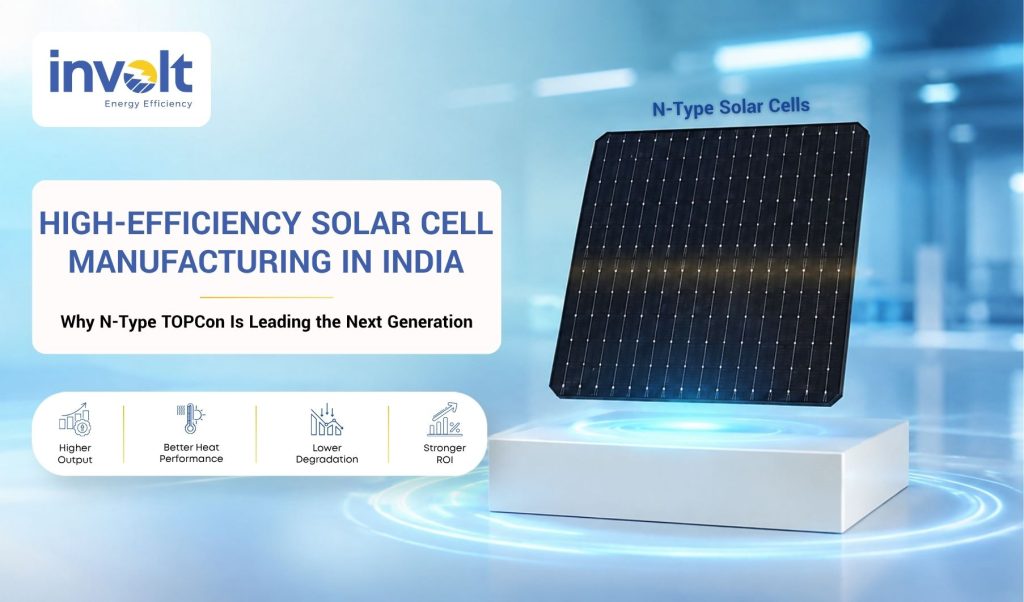
India’s solar industry is moving toward higher-efficiency solar cells, and advanced cell technology now plays a critical role in improving energy generation, reliability, and long-term performance. High-efficiency solar cells combine optimized cell architecture, effective passivation, quality silicon, and precise manufacturing to reduce energy losses. At the same time, India’s growing clean-energy demand is increasing the need for reliable domestic solar cell manufacturing. N-Type TOPCon technology stands out for its strong efficiency potential and advanced passivated-contact design. Involt Energy Pvt. Ltd. is contributing to this shift as an Indian manufacturer focused on high-efficiency N-Type TOPCon solar cells, with its manufacturing facility in Gujarat.
What Is a High-Efficiency Solar Cell?
A high-efficiency solar cell converts a greater share of incoming sunlight into usable electrical energy. Its performance depends on cell architecture, silicon quality, passivation, carrier collection, and manufacturing precision. N-Type TOPCon technology improves these factors through advanced passivated contacts and efficient charge collection.
What Makes a Solar Cell Highly Efficient?
Solar cell efficiency measures how effectively a cell converts sunlight into electrical energy. High conversion efficiency depends on several technical factors working together. First, high-quality silicon wafers provide a strong foundation for consistent cell performance. Next, effective surface passivation reduces carrier recombination and helps preserve generated charge. In addition, optimized cell structures reduce electrical losses during current collection. Precise manufacturing also matters because small variations in processing can affect efficiency, reliability, and output. Therefore, a high-efficiency solar cell requires more than advanced technology alone. It requires quality materials, controlled processes, effective passivation, low electrical losses, and accurate manufacturing at every stage.
How Is Solar Cell Efficiency Calculated?
Solar cell efficiency expresses the percentage of incoming solar power that a cell converts into electrical power.
Solar Cell Efficiency (%) = Electrical Power Output ÷ Incident Solar Power × 100
For example, if a cell receives 100 units of solar energy and produces 25 units of electrical energy, its conversion efficiency equals 25%.
What Factors Affect Solar Cell Efficiency?
Several technical factors directly influence solar cell efficiency:
-
Wafer quality: High-quality silicon supports better electrical performance.
-
Carrier recombination: Lower recombination helps retain more generated charge.
-
Passivation: Effective passivation reduces losses at semiconductor surfaces and contacts.
-
Electrical losses: Optimized contacts and cell structures reduce resistance-related losses.
-
Manufacturing precision: Consistent processing helps maintain uniform electrical performance across cells.
-
Cell architecture: Advanced designs can improve charge collection and overall conversion efficiency.
What Is Solar Cell Efficiency?
Solar cell efficiency is the percentage of sunlight that a solar cell converts into electrical energy. Higher efficiency means the cell converts more of the available solar energy into usable electricity under defined testing conditions.
How Can Solar Cell Efficiency Be Improved?
Manufacturers can improve solar cell efficiency by using high-quality silicon wafers, reducing carrier recombination, improving surface and contact passivation, minimizing electrical resistance, optimizing cell architecture, and maintaining precise manufacturing processes. Advanced technologies such as N-Type TOPCon combine several of these approaches to achieve high efficiency.
Why N-Type Solar Cells Support High-Efficiency Manufacturing
N-Type solar cell technology provides a strong foundation for high-efficiency solar cell manufacturing. Its material properties support longer carrier lifetimes and help reduce recombination losses. As a result, manufacturers can design cell structures that collect and retain more of the charge generated by sunlight. N-Type technology also works well with advanced passivation methods, which further improve electrical performance. In addition, N-Type solar cells can deliver strong performance stability under demanding operating conditions. These advantages make N-Type technology an important platform for the development of high-efficiency solar cells and advanced cell manufacturing in India.
Why Are N-Type Solar Cells Used for High-Efficiency Cells?
N-Type solar cells support high efficiency because they can achieve longer carrier lifetimes and lower recombination losses. Their structure also works effectively with advanced passivation techniques. Together, these characteristics help improve charge collection, reduce electrical losses, and increase the efficiency potential of the finished solar cell.
What Makes N-Type Technology Important for India?
India needs high-efficiency solar cells that can deliver strong energy performance while supporting large-scale domestic manufacturing. N-Type technology gives Indian solar cell manufacturers a pathway toward advanced cell architectures and improved efficiency. Its compatibility with modern passivation and contact technologies also supports the production of high-performance solar cells at scale.
For India’s growing solar manufacturing ecosystem, this creates an important opportunity. N-Type solar cell manufacturing can help strengthen domestic supply while meeting increasing demand for advanced solar cell technology. Involt Energy Pvt. Ltd. focuses on N-Type TOPCon solar cell manufacturing in India, with its manufacturing facility in Gujarat.
Why Are N-Type Solar Cells More Efficient?
N-Type solar cells can achieve high efficiency because their material properties support longer carrier lifetimes, lower recombination losses, and effective passivation. These characteristics help the cell retain and collect more of the electrical charge generated from sunlight, creating strong efficiency potential for advanced cell technologies such as N-Type TOPCon.
What Is N-Type TOPCon Solar Cell Technology?
N-Type TOPCon is an advanced solar cell technology that combines an N-Type silicon wafer with a highly engineered passivated contact structure. TOPCon stands for Tunnel Oxide Passivated Contact. The technology uses an extremely thin tunnel oxide layer and a conductive contact layer to improve carrier collection while limiting carrier recombination. This structure helps preserve more of the electrical charge generated inside the solar cell. As a result, manufacturers can achieve higher conversion efficiency and strong electrical performance. N-Type TOPCon has therefore become an important technology for high-efficiency solar cell manufacturing and advanced solar cell production in India.
How Does TOPCon Solar Cell Technology Work?
TOPCon technology works by creating a controlled passivated contact at the silicon surface. First, the N-Type silicon wafer absorbs sunlight and generates charge carriers. The ultra-thin tunnel oxide layer then helps passivate the silicon surface and reduces unwanted carrier recombination. A conductive layer works with the tunnel oxide to collect charge efficiently. This combination allows more carriers to reach the electrical contacts instead of being lost through recombination. Consequently, the cell can achieve improved charge collection and higher efficiency.
In simple terms: TOPCon reduces charge losses at the silicon contact while helping the solar cell collect more of the electricity generated by sunlight.
Why Are N-Type TOPCon Cells Highly Efficient?
N-Type TOPCon cells achieve high efficiency because they combine the strong electrical properties of N-Type silicon with advanced passivated-contact technology. The tunnel oxide helps reduce surface recombination, while the contact structure supports efficient carrier collection. This reduces electrical losses and allows more generated charge to contribute to useful electrical output.
The technology also provides a strong platform for continued efficiency improvements. For manufacturers, precise control of wafer quality, passivation, contact formation, metallization, and other production stages remains essential. Therefore, TOPCon technology alone does not determine final cell performance. Advanced technology plus consistent manufacturing quality creates high-efficiency N-Type TOPCon solar cells.
What Does TOPCon Mean in Solar Cells?
TOPCon means Tunnel Oxide Passivated Contact. It describes a solar cell structure that uses a very thin tunnel oxide layer and a passivated contact to reduce carrier recombination and improve carrier collection. This design helps increase the efficiency potential of N-Type solar cells.
How Does TOPCon Solar Cell Technology Work?
TOPCon solar cell technology uses a thin tunnel oxide and passivated contact to control carrier movement at the silicon surface. The structure reduces recombination losses and improves carrier collection. As a result, more of the charge generated by sunlight contributes to electrical power, supporting higher solar cell efficiency.
What Determines the Real-World Performance of N-Type TOPCon Solar Cells?
High efficiency alone does not define the performance of a solar cell. Real-world results also depend on temperature response, bifaciality, low-light behavior, degradation, and reliability. For N-Type TOPCon solar cells, these factors can influence energy yield throughout the operating life of a solar project. Therefore, buyers should evaluate more than the headline efficiency percentage. They should also consider the cell’s temperature coefficient, bifacial performance, degradation characteristics, and quality-control standards. These parameters help determine how consistently a high-efficiency solar cell can perform under different operating conditions.
Temperature Coefficient
The solar cell temperature coefficient shows how cell performance changes as temperature rises. Solar cells generally produce less power as their operating temperature increases. Therefore, a lower temperature coefficient can help a cell retain more of its power output in hot conditions.
Involt Energy’s TOPCon cell specifies a power temperature coefficient as low as -0.30%/K, supporting stronger power retention as operating temperatures increase.
This factor matters particularly in regions that experience high ambient temperatures. The N-Type solar cell temperature coefficient and TOPCon solar cell temperature coefficient therefore deserve attention when buyers evaluate cell performance for demanding climates.
Why Is a Lower Temperature Coefficient Important?
A lower temperature coefficient helps a solar cell maintain stronger power performance as its temperature increases. Consequently, it can support better energy yield during hot operating conditions. However, buyers should always evaluate the manufacturer’s certified temperature coefficient and test conditions rather than rely on a generic technology claim.
Bifaciality
Solar cell bifaciality describes the ability of a bifacial cell to generate electrical power from light reaching both its front and rear sides. The rear side can capture reflected and scattered light from the surrounding environment.
TOPCon solar cell bifaciality can therefore contribute to additional energy generation when project conditions provide useful rear-side irradiance. Ground reflectivity, mounting configuration, spacing, and surrounding surfaces all influence the actual gain.
The Involt Energy TOPCon cell specifies bifacial efficiency of ≥80%, supporting additional energy-generation potential when useful rear-side irradiance reaches the cell.
What Is Bifaciality in a Solar Cell?
Bifaciality represents the relationship between the electrical performance of a solar cell’s rear side and its front side under specified testing conditions. Higher bifaciality can increase the energy-generation potential of a bifacial solar cell when sufficient light reaches its rear surface.
Low-Light Performance
Solar cells encounter changing light conditions throughout the day. Morning and evening periods, cloud cover, haze, and diffuse sunlight can all reduce irradiance. Therefore, N-Type solar cell low-light performance and TOPCon solar cell low-light performance can influence energy production when sunlight intensity changes.
Involt Energy’s TOPCon cell specifies relative conversion efficiency above 97% under 200 W/m² low-light conditions, highlighting its designed performance under reduced irradiance.
How Does Low-Light Performance Affect Solar Energy Generation?
Low-light performance describes how effectively a solar cell continues to convert available sunlight when irradiance decreases. Strong low-light behavior can help a cell generate useful electricity during periods of weaker sunlight, although actual energy yield depends on weather, system design, orientation, temperature, and other site conditions.
Degradation and Reliability
A high-efficiency solar cell must maintain its performance over time. Solar cell degradation refers to the gradual reduction in electrical performance during operation. Manufacturers and buyers therefore need to consider degradation mechanisms, test results, material quality, and manufacturing controls.
N-Type technology can offer advantages against certain degradation mechanisms, but actual performance depends on the specific cell design and manufacturing process. Buyers should review verified specifications instead of assuming that every N-Type TOPCon solar cell has identical degradation behavior.
The Involt Energy TOPCon cell specifies light-induced degradation at 0 and excellent anti-PID performance, supporting its focus on long-term cell reliability.
What Are LID and PID in Solar Cells?
LID, or light-induced degradation, describes performance changes that can occur after a solar cell experiences light exposure. PID, or potential-induced degradation, refers to performance losses associated with electrical potential differences and operating conditions within a solar installation.
Manufacturers evaluate these mechanisms through appropriate reliability testing. Anti-PID performance therefore forms an important part of solar cell quality evaluation.
How Reliable Are N-Type TOPCon Solar Cells?
N-Type TOPCon solar cells can provide strong long-term reliability when manufacturers use appropriate materials, controlled processes, effective passivation, robust contacts, and rigorous quality testing. Buyers should evaluate certified electrical specifications, degradation data, reliability tests, and manufacturing quality before selecting a solar cell supplier.
How Are High-Efficiency Solar Cells Manufactured?
High-efficiency solar cell manufacturing requires precise control at every production stage. A high-quality silicon wafer provides the foundation. Manufacturers then prepare the wafer, optimize its surface, create the required electrical structure, apply passivation, form the TOPCon contact, and complete metallization and firing. After processing, manufacturers perform electrical testing, electroluminescence inspection, defect checks, and cell sorting. Each stage can influence the final electrical performance of the cell. Therefore, consistent process control matters as much as the underlying technology. For N-Type TOPCon solar cells, manufacturing precision helps maintain uniform electrical characteristics, reduce defects, improve charge collection, and deliver consistent cell performance.
High-quality silicon wafer → wafer preparation → surface treatment → doping → passivation → TOPCon contact formation → metallization → firing → electrical testing → EL inspection → sorting
Why Is Passivation Important in TOPCon Solar Cells?
Passivation plays a critical role in high-efficiency solar cell manufacturing. It reduces unwanted electrical losses at the silicon surface and helps limit carrier recombination. In TOPCon cells, the tunnel oxide and passivated contact structure work together to protect the silicon interface while supporting effective carrier collection.
Effective passivation therefore helps preserve more of the charge generated by sunlight. However, manufacturers must control the process carefully. Small variations in material quality, layer formation, temperature, or processing conditions can affect the final cell performance.
How Does Manufacturing Quality Affect Solar Cell Performance?
Manufacturing quality directly affects solar cell efficiency, consistency, reliability, and long-term performance. High-quality materials alone cannot guarantee a high-performing cell. Manufacturers also need precise process control across wafer preparation, doping, passivation, contact formation, metallization, and firing.
Consistent manufacturing helps reduce defects and electrical variations between cells. It also supports uniform current and voltage characteristics across production batches. For buyers, this consistency matters because predictable cell performance supports reliable downstream manufacturing and project-level energy expectations.
For an advanced N-Type TOPCon solar cell manufacturer, quality control must therefore operate throughout the production process rather than only at the final inspection stage.
How Are Solar Cells Tested for Quality?
Manufacturers use several quality-control methods to evaluate solar cells before shipment. Electrical testing measures key performance characteristics and helps identify cells that fall outside defined specifications. EL testing provides another important layer of inspection by revealing internal defects that may not appear during a visual examination.
Manufacturers can also use visual inspection, dimensional checks, process monitoring, defect inspection, and batch-level consistency checks. Together, these controls help identify manufacturing variations and maintain product quality.
What Is EL Testing in Solar Cells?
EL testing, or electroluminescence testing, is a non-destructive inspection method that helps identify internal defects in a solar cell. The test applies an electrical current to the cell and captures the resulting light emission with a specialized camera. Manufacturers can use the resulting EL image to detect cracks, inactive areas, broken fingers, and other electrical or structural abnormalities.
EL testing therefore helps manufacturers identify defects that a standard visual inspection may miss. It plays an important role in quality control for high-efficiency solar cells.
Why India Needs Advanced Solar Cell Manufacturing
India’s solar industry needs more than growing installation capacity. It also needs a stronger domestic manufacturing base that can produce advanced, high-efficiency solar cells at scale. As demand for solar power continues to grow, reliable access to high-quality cells becomes increasingly important for India’s solar supply chain.
Advanced solar cell manufacturing in India can reduce dependence on overseas supply, strengthen supply-chain resilience, and support faster adoption of newer cell technologies. At the same time, domestic production can help Indian buyers source high-efficiency cells closer to their manufacturing and project markets.
The growth of N-Type solar cell manufacturing in India also reflects this technology shift. Manufacturers are investing in advanced production capabilities to meet demand for higher-performance cells and modern cell architectures.
Building a Strong Domestic Solar Cell Supply Chain
A stronger domestic manufacturing ecosystem gives India greater control over solar cell production, quality standards, technology adoption, and supply availability. It also creates opportunities for Indian manufacturers to develop advanced production capabilities instead of relying primarily on imported cells.
For buyers, working with an Indian solar cell manufacturer can also simplify communication, technical coordination, sourcing, and supply planning. As domestic capacity grows, manufacturers can serve both Indian demand and international markets.
Why High-Efficiency Cells Matter for India’s Solar Industry
India needs high-efficiency solar cells to support better use of available space and improve energy-generation potential. Therefore, advanced technologies such as N-Type TOPCon have become increasingly important within India’s evolving cell manufacturing landscape.
Made in India solar cells can also strengthen the country’s position as a competitive solar manufacturing hub. With investments in advanced production facilities, automation, quality control, and next-generation cell technologies, solar cell production in India is moving toward a more technology-focused and resilient manufacturing ecosystem.
Involt Energy Pvt. Ltd. is part of this transition. The company focuses on N-Type TOPCon solar cell manufacturing and is developing advanced domestic production capacity in Gujarat, supporting India’s move toward high-efficiency, Made in India solar cells.
Why Gujarat Is Becoming a Solar Cell Manufacturing Hub
Gujarat is emerging as an important destination for solar cell manufacturing in India because of its strong industrial ecosystem, infrastructure, renewable-energy focus, and growing investment in solar manufacturing. The state provides an established base for companies developing advanced manufacturing facilities and expanding domestic solar production.
This growth is creating opportunities for solar cell manufacturers in Gujarat to focus on newer technologies and higher-efficiency products. In particular, N-Type and TOPCon technologies are becoming increasingly relevant as India’s solar industry moves toward advanced cell architectures.
For buyers searching for a solar cell manufacturer in Gujarat, the state’s growing manufacturing ecosystem offers access to domestic production, technical capabilities, and an expanding supply base. It also strengthens Gujarat’s position within India’s broader solar manufacturing landscape.
Why Is Gujarat Important for Solar Cell Manufacturing?
Gujarat is important for solar cell manufacturing because it combines industrial infrastructure, renewable-energy development, manufacturing investment, and access to an established business ecosystem. These factors make the state well suited for large-scale solar manufacturing facilities and advanced production technologies.
The growth of N-Type solar cell manufacturing in Gujarat further strengthens the state’s position in India’s next generation of solar production. Manufacturers developing N-Type TOPCon capacity can support India’s increasing demand for high-efficiency solar cells while contributing to domestic supply-chain development.
As this ecosystem expands, Gujarat is positioned to support manufacturers, suppliers, technology partners, and buyers across the solar value chain. For companies seeking a high-efficiency solar cell manufacturer in Gujarat or a reliable solar cell supplier in Gujarat, the state’s expanding manufacturing base provides an increasingly important sourcing ecosystem.
Involt Energy Pvt. Ltd. contributes to this ecosystem through its focus on N-Type TOPCon solar cell manufacturing in Gujarat. Its manufacturing facility in the Rajkot region reinforces Gujarat’s growing role in India’s advanced solar cell production.
Solar Cell Manufacturing in Rajkot: Involt Energy’s Gujarat Presence
Rajkot is gaining importance within Gujarat’s expanding advanced manufacturing ecosystem, and solar cell manufacturing is becoming part of that growth. Involt Energy Pvt. Ltd. is strengthening this regional connection through its planned N-Type TOPCon solar cell manufacturing facility in the Rajkot district of Gujarat.
The facility gives Involt Energy a strong foundation as a solar cell manufacturer in Rajkot and supports the company’s focus on high-efficiency N-Type TOPCon technology. With a planned initial annual capacity of 1.78 GW, the facility represents a significant step toward expanding domestic solar cell production in Gujarat.
For buyers searching for a N-Type solar cell manufacturer in Rajkot, N-Type TOPCon solar cell manufacturer in Rajkot, or TOPCon solar cell manufacturer in Rajkot, Involt Energy offers a clear Indian manufacturing story focused specifically on solar cells.
Involt Energy’s Role in Rajkot’s Solar Manufacturing Growth
Involt Energy is developing its solar cell manufacturing facility in the Rajkot region with a focus on N-Type TOPCon technology and advanced automated production. The project supports India’s broader move toward domestic manufacturing of high-efficiency solar cells.
This focus also gives Involt Energy a strong position for future solar cell production in Rajkot and Gujarat. As the facility progresses toward commercial production, it can contribute to a stronger domestic supply base for high-efficiency N-Type TOPCon solar cells.
For manufacturers and buyers looking for a solar cell supplier in Rajkot or a high-efficiency solar cell manufacturing partner in Gujarat, Involt Energy’s dedicated focus on N-Type TOPCon technology provides a clear point of differentiation.
The company’s Rajkot-region facility also strengthens the connection between solar manufacturing in Rajkot, Gujarat’s industrial ecosystem, and India’s growing advanced solar cell manufacturing capacity.
Involt Energy: High-Efficiency N-Type TOPCon Solar Cell Manufacturer in India
Involt Energy Pvt. Ltd. is building its position as a dedicated N-Type TOPCon solar cell manufacturer in India, with a clear focus on high-efficiency solar cell technology and domestic manufacturing. Unlike companies that operate across multiple parts of the solar value chain, Involt Energy focuses specifically on solar cells. This focused approach allows the company to concentrate its manufacturing capabilities, technology development, quality systems, and product strategy around advanced N-Type TOPCon cells.
Involt Energy’s TOPCon cell combines high conversion efficiency with performance-focused characteristics. The product specifies front efficiency of ≥25.3%, bifacial efficiency of ≥80%, a power temperature coefficient as low as -0.30%/K, and relative conversion efficiency above 97% under 200 W/m² low-light conditions. The cell also specifies zero light-induced degradation and excellent anti-PID performance.
The company’s manufacturing project in Gujarat further strengthens this positioning. Involt Energy is developing a planned 1.78 GW annual N-Type TOPCon solar cell manufacturing facility in the Rajkot region of Gujarat. The facility is designed around advanced and highly automated manufacturing, supporting consistent production and scalable domestic capacity.
Explore Involt Energy N-Type TOPCon Solar Cells →https://involtenergy.com/products
A Dedicated Focus on N-Type TOPCon Solar Cells
N-Type TOPCon technology sits at the center of Involt Energy’s product strategy. The company focuses on developing and manufacturing high-efficiency N-Type TOPCon solar cells rather than treating the technology as one product among many.
This dedicated approach matters because high-efficiency cell manufacturing requires close control over materials, cell architecture, passivation, contact formation, metallization, testing, and process consistency. A focused N-Type TOPCon solar cell manufacturer can therefore build its manufacturing capabilities around the specific requirements of this advanced cell technology.
For buyers searching for a N-Type TOPCon solar cell manufacturer in India, Involt Energy provides a clear technology-focused manufacturing proposition.
Advanced Manufacturing in Gujarat
Involt Energy’s planned manufacturing facility in Gujarat represents an important step toward expanding India’s domestic solar cell production. The planned 1.78 GW annual capacity provides a scalable foundation for high-efficiency N-Type TOPCon solar cell manufacturing.
The facility also incorporates advanced automated manufacturing concepts. Automation can support consistent process control, material handling, production monitoring, and repeatable manufacturing outcomes. These capabilities become increasingly important as manufacturers scale production while maintaining strict quality requirements.
The Gujarat location also connects Involt Energy with one of India’s major industrial and renewable-energy markets. As a result, the company can contribute to the development of a stronger domestic ecosystem for advanced solar cell manufacturing.
Supporting India’s Domestic Solar Cell Manufacturing
India’s transition toward domestic solar manufacturing requires more than additional production capacity. It requires manufacturers that can develop and produce advanced cell technologies within the country.
Involt Energy is contributing to this objective through its focus on Made in India solar cells and N-Type TOPCon technology. Its manufacturing project supports the broader development of India’s domestic solar cell supply chain and can help increase the availability of advanced high-efficiency cells from an Indian manufacturer.
For buyers evaluating an Indian solar cell manufacturer, this domestic focus can offer advantages in sourcing coordination, technical communication, supply planning, and engagement with an India-based manufacturing ecosystem.
N-Type TOPCon Solar Cell Supplier for India’s Growing Demand
As demand for high-efficiency cells increases, buyers need reliable manufacturers and suppliers that understand advanced cell technology. Involt Energy’s dedicated focus on N-Type TOPCon positions the company to serve this growing requirement.
The company’s positioning extends across the commercial search landscape, including N-Type TOPCon solar cell manufacturer, N-Type TOPCon solar cell manufacturer India, TOPCon solar cell manufacturer India, N-Type solar cell supplier India, and TOPCon solar cell supplier India.
However, the value proposition goes beyond keywords. Involt Energy combines a dedicated N-Type TOPCon product focus, planned large-scale manufacturing capacity, Gujarat-based production infrastructure, and an emphasis on advanced manufacturing.
Explore Involt Energy’s N-Type TOPCon Solar Cells
Businesses looking for high-efficiency solar cells can explore Involt Energy’s N-Type TOPCon solar cell product range and technical information directly through the company’s website.
Explore the Products:
Involt Energy N-Type TOPCon Solar Cells – Products
With its dedicated technology focus and planned 1.78 GW manufacturing capacity in Gujarat, Involt Energy is working to strengthen India’s domestic supply of advanced N-Type TOPCon solar cells while building a scalable foundation for future solar cell production.
Frequently Asked Questions About High-Efficiency N-Type TOPCon Solar Cells
What Is a High-Efficiency Solar Cell?
A high-efficiency solar cell converts a larger percentage of sunlight into electrical energy. Its performance depends on silicon quality, cell architecture, passivation, carrier collection, electrical resistance, and manufacturing precision. Advanced technologies such as N-Type TOPCon help manufacturers achieve strong efficiency potential.
Why Are N-Type TOPCon Cells Highly Efficient?
N-Type TOPCon cells achieve high efficiency by combining N-Type silicon with a passivated-contact structure. The tunnel oxide and contact layer help reduce carrier recombination while supporting efficient carrier collection. This combination can reduce electrical losses and improve the cell’s conversion efficiency.
How Efficient Are TOPCon Solar Cells?
TOPCon solar cell efficiency depends on cell design, wafer quality, manufacturing processes, and testing conditions. Commercial efficiency levels vary between products and manufacturers. Therefore, buyers should evaluate the manufacturer’s verified electrical specifications rather than rely on a single general efficiency figure for all TOPCon cells.
What Is the Temperature Coefficient of a TOPCon Solar Cell?
The temperature coefficient indicates how a solar cell’s electrical performance changes as its temperature increases. A lower temperature coefficient helps the cell retain more power in hot conditions. Buyers should check the manufacturer’s certified temperature coefficient and applicable testing conditions before comparing products.
What Is Bifaciality in a Solar Cell?
Bifaciality describes a solar cell’s ability to generate electrical power from light reaching both its front and rear surfaces. High bifaciality can increase energy-generation potential when rear-side irradiance is available. Actual gains depend on ground reflectivity, installation design, spacing, and surrounding conditions.
How Do N-Type TOPCon Solar Cells Perform in Low Light?
N-Type TOPCon solar cells can maintain useful electrical generation under lower irradiance conditions. Morning, evening, cloudy weather, and diffuse sunlight can create low-light conditions. Actual low-light performance depends on the cell design, operating environment, temperature, irradiance, and complete system configuration.
Do N-Type TOPCon Solar Cells Have Lower Degradation?
N-Type TOPCon technology can provide strong resistance to certain degradation mechanisms, but actual degradation depends on the specific cell design, materials, manufacturing process, and operating conditions. Buyers should review verified degradation data and reliability-test results instead of assuming identical performance across all TOPCon products.
What Is LID in Solar Cells?
LID means light-induced degradation. It describes changes in solar cell performance that can occur after exposure to light. Manufacturers evaluate LID behavior through appropriate testing. N-Type technologies can offer advantages against certain degradation mechanisms, depending on the specific cell structure and manufacturing process.
What Is PID in Solar Cells?
PID means potential-induced degradation. It describes performance losses associated with electrical potential differences and operating conditions within a solar installation. Manufacturers evaluate anti-PID performance through reliability testing. Buyers should review verified test results and product specifications when assessing the long-term reliability of solar cells.
How Are High-Efficiency Solar Cells Manufactured?
High-efficiency solar cells require precise control throughout manufacturing. Key stages include wafer preparation, surface treatment, doping, passivation, contact formation, metallization, firing, electrical testing, EL inspection, and sorting. Consistent process control helps manufacturers reduce defects, improve electrical performance, and maintain product uniformity.
How Are Solar Cells Tested for Quality?
Manufacturers use electrical testing, electroluminescence testing, visual inspection, dimensional checks, defect detection, and process monitoring to evaluate solar cell quality. EL testing can reveal internal cracks and inactive areas that visual inspection may miss. These controls help maintain consistent electrical performance across production batches.
What Is EL Testing in Solar Cells?
EL testing, or electroluminescence testing, is a non-destructive inspection method for identifying internal solar cell defects. Manufacturers apply electrical current and capture the resulting light emission with a specialized camera. EL images can reveal cracks, inactive regions, broken fingers, and other abnormalities.
Who Manufactures N-Type TOPCon Solar Cells in India?
India has a growing base of advanced solar cell manufacturers developing N-Type and TOPCon production capabilities. Involt Energy Pvt. Ltd. focuses specifically on N-Type TOPCon solar cells and is developing a planned 1.78 GW manufacturing facility in Gujarat.
Why Is Gujarat Important for Solar Cell Manufacturing?
Gujarat offers a strong industrial ecosystem, manufacturing infrastructure, renewable-energy focus, and increasing investment in solar production. These factors support large-scale domestic manufacturing. The state’s growing N-Type TOPCon manufacturing activity also strengthens its role in India’s high-efficiency solar cell supply chain.
Where Can I Buy N-Type TOPCon Solar Cells in India?
Businesses looking for N-Type TOPCon solar cells can source them from specialized Indian solar cell manufacturers and suppliers. Involt Energy focuses on N-Type TOPCon solar cells and is developing domestic manufacturing capacity in Gujarat. Buyers can explore its product information and technical specifications online.
Choose Involt Energy for N-Type TOPCon Solar Cells
High-efficiency solar cell manufacturing starts with the right technology and consistent manufacturing quality. Involt Energy Pvt. Ltd. focuses on N-Type TOPCon solar cells and advanced domestic manufacturing in Gujarat. For businesses seeking high-efficiency solar cells from an Indian manufacturer, Involt Energy offers a focused technology and manufacturing proposition.
Explore Products → N-Type TOPCon Solar Cells by Involt Energy
Products: https://involtenergy.com/products
Contact Involt Energy
Request a Call:
+91 7574994400
+91 7574995500
Email:
[email protected]
Office Address:
S.No. 85, P7/P1,
Mitana–Wankaner Road,
At: Bhutkotda, Mitana,
Rajkot, Gujarat – 363650, India