
TOPCon Solar Cell Manufacturing Process: Step-by-Step Guide
Explore the manufacturing stages used to transform a silicon wafer into an N-Type TOPCon solar cell, from texturing and passivated contact formation to metallization, testing, sorting and automatic packing.
What This Guide Covers
- TOPCon solar cell production stages
- Surface texturing and diffusion
- Passivated contact formation
- Deposition and metallization
- Testing, sorting and packing
- Involt Energy’s intelligent manufacturing approach
What Is the TOPCon Solar Cell Manufacturing Process?
The TOPCon solar cell manufacturing process combines silicon wafer preparation, surface engineering, diffusion, passivation, contact formation, metallization and electrical testing to produce high-performance photovoltaic cells.
In the Involt Energy process flow shown on this page, the production sequence progresses through Texturing, B-Diffusion & Oxidation, BSG + Polishing, PE-Poly, Annealing, RCA, ALD, F-PECVD, R-PECVD, Printing, Firing & Testing/Sorter, and Automatic Packing.
How Are N-Type TOPCon Solar Cells Manufactured?
TOPCon manufacturing requires carefully controlled processing at each stage. The following process flow reflects the manufacturing sequence presented by Involt Energy.
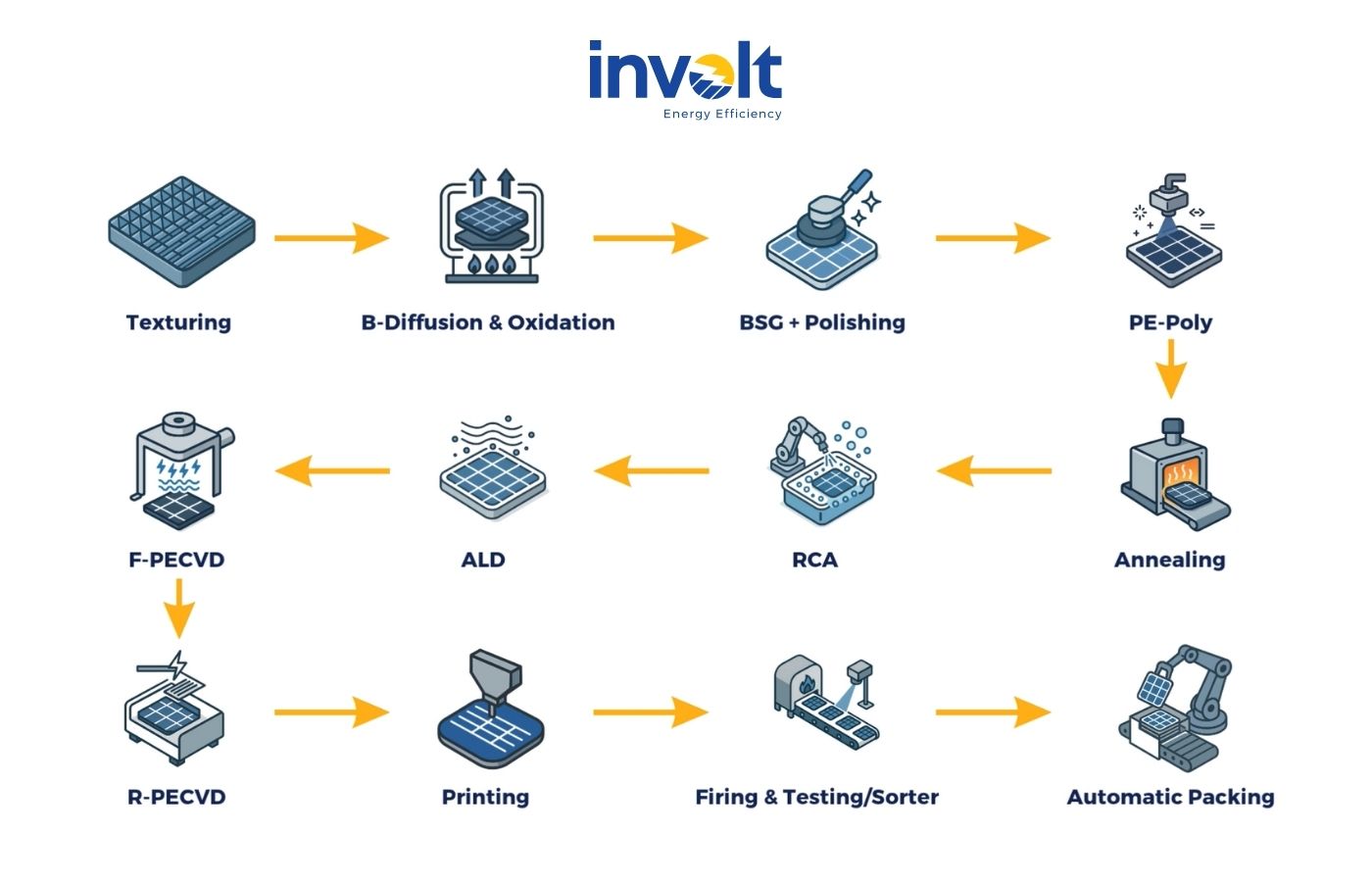
TOPCon Solar Cell Manufacturing Process Explained
Each stage has a specific role in preparing the wafer, forming the required junction and passivated-contact structures, applying functional layers, creating electrical contacts and validating the finished cell.
Texturing
The process begins with surface texturing of the silicon wafer. Texturing creates a microscopic surface structure that helps reduce optical reflection and improves the wafer’s ability to capture incoming light.
B-Diffusion & Oxidation
The textured wafer proceeds through boron diffusion and oxidation. Boron diffusion is used to form the required doped region of the cell, while controlled oxidation forms an oxide layer used within subsequent processing.
BSG + Polishing
After diffusion, the wafer undergoes processing associated with borosilicate glass (BSG) and polishing. This stage prepares the relevant wafer surface for the following contact and passivation processes.
PE-Poly
The PE-Poly stage is part of forming the polysilicon-based passivated-contact structure used in TOPCon cell architecture. Process control at this stage is important to achieving the intended electrical and passivation characteristics.
Annealing
The wafer then undergoes controlled thermal treatment. Annealing supports the development and stabilization of material and contact properties required by the TOPCon structure.
RCA
RCA cleaning is used to prepare the wafer surface for subsequent deposition processes by removing unwanted surface contamination and maintaining the cleanliness required for controlled semiconductor processing.
ALD
Atomic Layer Deposition (ALD) is used to form a highly controlled thin-film layer. Such deposition processes are important for surface passivation and for limiting charge-carrier recombination at relevant interfaces.
F-PECVD
Front-side Plasma Enhanced Chemical Vapor Deposition (F-PECVD) applies functional thin-film layers to the front side of the cell. These layers contribute to the optical and surface-passivation characteristics of the finished solar cell.
R-PECVD
Rear-side Plasma Enhanced Chemical Vapor Deposition (R-PECVD) applies the required rear-side thin-film layers. Controlled deposition supports the rear-surface properties required by the cell architecture.
Printing
Metallization patterns are printed onto the cell to create the electrical contacts required to collect and conduct current. Accurate printing is important for balancing electrical conductivity with optical shading and material use.
Firing & Testing/Sorter
Following printing, the cell undergoes firing to establish the required electrical contact characteristics. Finished cells are then electrically tested and sorted according to measured performance parameters and applicable quality criteria.
Automatic Packing
After testing and sorting, qualified solar cells proceed to automatic packing. Involt Energy’s intelligent manufacturing approach incorporates automated packing, quality-control intelligence and barcode traceability.
Why Manufacturing Control Matters for TOPCon Solar Cells
TOPCon performance depends not only on the cell architecture but also on how consistently individual manufacturing stages are controlled.
Surface Quality
Texturing, cleaning and surface preparation influence optical behaviour and the quality of subsequent deposited layers.
Passivation
Carefully controlled passivation and contact structures help limit recombination losses that can reduce cell performance.
Layer Uniformity
Controlled deposition is important for maintaining consistent thin-film properties across the solar cell surface.
Metallization
Printing and firing must form reliable electrical contacts while managing resistance, shading and process consistency.
Electrical Testing
Finished cells are measured and sorted so their electrical characteristics can be evaluated before packing.
Traceability
Digital manufacturing and barcode-based traceability help connect production information with quality-control processes.
How the Manufacturing Process Creates a TOPCon Cell
TOPCon stands for Tunnel Oxide Passivated Contact. Its defining concept is a passivated-contact structure designed to reduce charge-carrier recombination while enabling effective electrical transport.
Manufacturing therefore requires more than simply forming a conventional silicon junction. Surface preparation, passivation, polysilicon-related processing, thin-film deposition, metallization and thermal treatment must work together as part of the complete cell architecture.
For a deeper explanation of the underlying architecture, read our guide to TOPCon solar cell technology .
N-Type vs TOPCon: What Is the Difference?
N-Type describes the type of silicon substrate, while TOPCon describes the passivated-contact architecture used in the solar cell.
Many commercial TOPCon cells use N-Type silicon, which is why the terms are frequently encountered together. However, they describe different aspects of the cell.
This distinction is important when evaluating solar cell technologies, manufacturing processes and supplier specifications.
Intelligent Manufacturing for N-Type TOPCon Solar Cells
At Involt Energy, manufacturing is driven by automation, process intelligence and data. The company’s smart production environment is designed to support accuracy, consistency, traceability and scalable N-Type TOPCon solar cell manufacturing.
- Fully automatic production line
- AGV-based material movement
- MES-driven shop-floor intelligence
- Digital twin integration
- Statistical Process Control (SPC)
- Automated Optical Inspection (AOI)
- Barcode-based traceability
- Automatic packing with QC intelligence
Explore Involt Energy’s Intelligent Manufacturing capabilities for additional information about its production environment.
What Should Buyers Evaluate in a TOPCon Manufacturing Process?
For module manufacturers and procurement teams, a manufacturing process should be evaluated together with actual product specifications, quality controls and supplier capabilities.
Buyers comparing manufacturing sources across India can also review our guide to TOPCon solar cell manufacturers in India , covering identified cell-manufacturing activity, manufacturing locations, TOPCon technology and the key factors B2B procurement teams should consider when building a supplier shortlist.
Product Specifications
Review the supplier’s current approved solar cell datasheet and compare the electrical and physical parameters relevant to your module design.
Process Consistency
Understand how the manufacturer controls production stages and monitors process variation across manufacturing.
Quality Inspection
Consider how cells are inspected, electrically tested, sorted and validated before packing and shipment.
Traceability
Traceability systems can help connect production and quality information with finished-cell batches.
Automation
Automated handling and production systems can support repeatability and reduce unnecessary manual intervention.
Technical Communication
Procurement teams should confirm current specifications, qualification requirements and supply needs directly with the manufacturer.
For finished-cell sourcing and module production requirements, explore our N-Type TOPCon solar cells for module manufacturers in India covering G12R 16BB specifications, module compatibility, quality assurance and B2B procurement considerations.
Where Does ALMM List-II Fit Into Solar Cell Procurement?
Manufacturing capability and process control are important parts of supplier evaluation. Where ALMM requirements are relevant to the intended project or procurement route, buyers should also verify the latest official ALMM List-II for solar PV cells.
Manufacturing Evaluation and ALMM Verification Are Different Checks
A manufacturing review helps buyers understand process control, testing, sorting, traceability and production capability. An ALMM check should separately verify the relevant manufacturer, manufacturing facility, solar cell model, validity and applicable MNRE requirements using the latest official List-II.
From Manufacturing Process to Manufacturer Selection
Understanding the TOPCon solar cell manufacturing process is only one part of supplier evaluation. B2B buyers should also review cell specifications, testing, sorting, quality control, traceability, technical documentation and supply capabilities.
How Does TOPCon Manufacturing Differ From PERC?
TOPCon and PERC use different solar cell architectures, which leads to differences in passivation, contacting and manufacturing requirements. Explore the comparison to understand how the two technologies differ beyond the production sequence.
TOPCon Solar Cell Manufacturing FAQs
Quick answers to common questions about N-Type TOPCon solar cell manufacturing and production.
What is the TOPCon solar cell manufacturing process?
TOPCon solar cell manufacturing combines wafer surface preparation, diffusion, passivated-contact formation, thin-film deposition, metallization, firing, electrical testing, sorting and packing. Specific process sequences and equipment can vary by manufacturer.
What does TOPCon stand for?
TOPCon stands for Tunnel Oxide Passivated Contact. It refers to a passivated-contact solar cell architecture designed to reduce charge-carrier recombination at contact interfaces.
Why is texturing used in TOPCon solar cell manufacturing?
Texturing modifies the silicon wafer surface to reduce optical reflection and improve light capture within the solar cell.
What is the role of passivation in a TOPCon solar cell?
Passivation is used to reduce charge-carrier recombination at surfaces and interfaces, helping preserve carriers that can contribute to electrical output.
What is ALD in solar cell manufacturing?
ALD stands for Atomic Layer Deposition. It is a thin-film deposition technique capable of forming highly controlled layers used in semiconductor and photovoltaic manufacturing.
What is PECVD in TOPCon solar cell production?
PECVD stands for Plasma Enhanced Chemical Vapor Deposition. It is used to deposit functional thin-film layers that contribute to passivation and optical properties of the solar cell.
Why are TOPCon solar cells tested and sorted?
Electrical testing measures finished-cell performance. Sorting then groups cells according to measured parameters and applicable quality criteria before packing.
Does Involt Energy manufacture N-Type TOPCon solar cells in India?
Yes. Involt Energy manufactures N-Type TOPCon solar cells at its manufacturing facility in Gujarat, India. Buyers should use the latest approved Involt product documentation when evaluating current product specifications.
How does Involt Energy support manufacturing traceability?
Involt Energy’s intelligent manufacturing environment includes MES-driven production monitoring, barcode traceability, automated quality-control systems and automatic packing.
Learn More About N-Type TOPCon Solar Cells
Explore related Involt Energy resources covering TOPCon technology, solar cell manufacturing and product capabilities.
N-Type TOPCon Solar Cell Manufacturing in Gujarat, India
Involt Energy Pvt. Ltd. manufactures N-Type TOPCon solar cells in Gujarat, India, with an emphasis on automated production, process control, quality and manufacturing intelligence. Buyers evaluating a Gujarat-based manufacturing source can learn more about Involt Energy as an N-Type TOPCon solar cell manufacturer in Gujarat , including its manufacturing location, G12R 16BB cell platform, quality controls and B2B supply capabilities.
Learn more about Involt Energy, explore our solar cell products, or visit Intelligent Manufacturing for more information about our manufacturing environment.
Looking for N-Type TOPCon Solar Cells?
For product specifications, procurement requirements and B2B enquiries, connect directly with Involt Energy.
Email: [email protected]
Phone: +91 7574994400
From Manufacturing Process to Cell Specifications
See how B2B buyers evaluate finished TOPCon solar cells through electrical parameters, dimensions, thickness, metallization, testing and module compatibility.
View the TOPCon Specifications Guide →Discuss Your N-Type TOPCon Solar Cell Requirements
Connect with Involt Energy for product information, technical requirements and B2B solar cell enquiries.
Contact Involt Energy