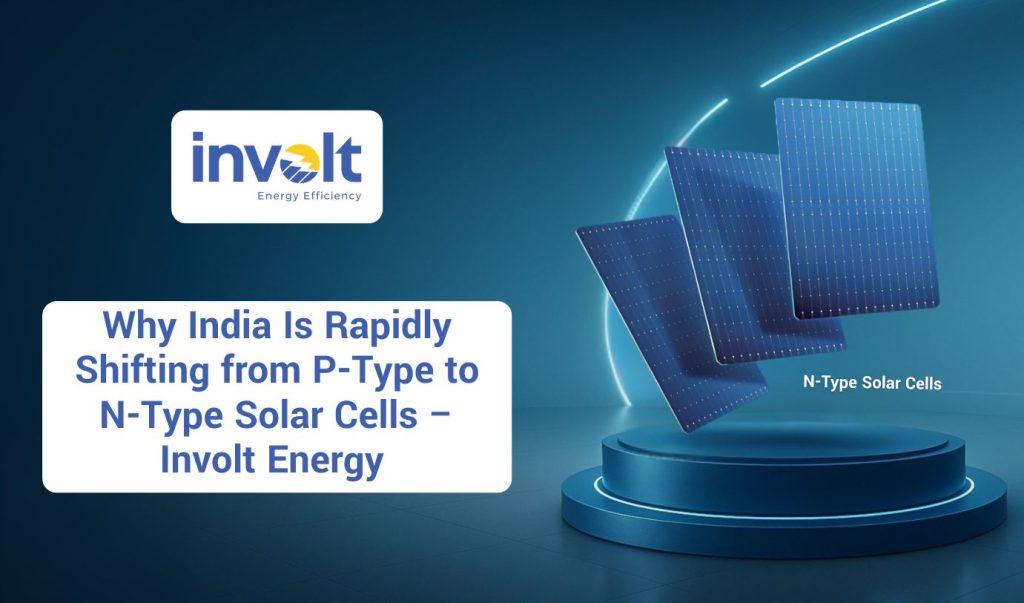
Why India Is Rapidly Shifting from P-Type to N-Type Solar Cells – Involt Energy
India’s Solar Industry Is Entering a New Performance Era
India’s solar industry is changing faster than ever before.
For years, the market focused heavily on one goal:
👉 Installing more solar capacity at lower upfront cost.
However, the industry is now entering a completely different phase — a performance-driven era.
Today, EPC companies, developers, module manufacturers, and investors are asking more important questions:
- Why do some solar projects lose output faster?
- Why does degradation impact long-term ROI?
- Which solar cell technology performs better in Indian climate conditions?
- How can utility-scale projects generate stable output for decades?
And the answer increasingly points toward one major industry transition:
👉 The shift from traditional P-Type solar cells to advanced N-Type solar cells.
Across India, demand for high-efficiency N-Type TOPCon solar cells is rising rapidly because the industry now prioritizes:
✔ Higher efficiency
✔ Lower degradation
✔ Better temperature performance
✔ Longer lifespan
✔ Stronger long-term energy yield
✔ Better solar project ROI
This shift is also accelerating because India’s renewable energy ecosystem is evolving rapidly under domestic manufacturing growth, utility-scale solar expansion, and next-generation solar technology adoption.
As a result, N-Type TOPCon technology is becoming one of the most discussed topics across the global solar industry.
Manufacturers, EPC companies, and developers increasingly view N-Type solar technology as the future of high-performance solar infrastructure in India.
At the center of this transition, companies like Involt Energy are focusing on advanced N-Type TOPCon solar cell manufacturing in Gujarat, India, supporting the country’s shift toward future-ready solar technology.
Why Is India Shifting from P-Type to N-Type Solar Cells?
India is rapidly shifting toward N-Type solar cells because they offer higher efficiency, lower degradation, better heat resistance, stronger long-term performance, and improved ROI compared to traditional P-Type solar cells.
What Is a P-Type Solar Cell?
P-Type solar cells played a major role in the growth of the global solar industry for many years.
They helped accelerate solar adoption because they were cost-effective, scalable, and widely available for large-scale manufacturing.
For a long time, most utility-scale, commercial, and industrial solar projects depended heavily on P-Type solar cell technology — especially Mono PERC solar cells.
However, as the solar industry evolved, developers and EPC companies started focusing more on long-term performance rather than only initial cost.
That shift exposed several limitations of conventional P-Type technology.
How P-Type Solar Cells Work
P-Type solar cells use silicon wafers doped with boron to create a positive charge carrier layer.
When sunlight hits the solar cell, electrons start moving and generate electricity through the photovoltaic process.
Most traditional Mono PERC solar cells use P-Type wafer technology because it enabled mass production at lower manufacturing costs for many years.
This technology dominated the market because it offered:
✔ Affordable manufacturing
✔ Faster large-scale adoption
✔ Established supply chains
✔ Easy scalability for solar expansion
As a result, P-Type solar cells became the standard choice across the global solar industry during the early growth phase of renewable energy adoption.
Mono PERC technology especially became popular because it improved efficiency compared to older conventional solar technologies.
However, the industry is now moving beyond basic efficiency improvements and focusing more on long-term solar project performance.
Limitations of P-Type Solar Cells
Although P-Type solar cells helped expand the solar market globally, they come with several performance limitations that impact long-term solar generation.
As solar projects become larger and more performance-driven, these limitations become more visible over time.
Higher Degradation Over Time
One of the biggest concerns with P-Type solar cells is higher degradation.
Over the years, solar output gradually declines faster compared to advanced N-Type solar cells.
This reduction affects:
- Long-term energy generation
- Solar plant performance ratio (PR)
- Project profitability
- Long-term ROI
For utility-scale solar projects, even small degradation losses can create significant financial impact over decades.
Light Induced Degradation (LID)
P-Type solar cells are more vulnerable to Light Induced Degradation (LID).
LID causes an early-stage efficiency drop when solar cells are exposed to sunlight during operation.
This means some performance loss starts relatively early in the project lifecycle.
As a result, developers increasingly prefer low LID solar technologies that maintain stable output over longer periods.
Performance Drop in High Temperatures
India’s climate creates another major challenge for traditional P-Type solar cells.
Many regions across India experience:
- High ambient temperatures
- Strong solar irradiation
- Long operational exposure
- Dust-heavy conditions
Under these conditions, conventional P-Type solar cells often experience greater thermal losses.
Higher temperatures can reduce efficiency and impact long-term energy yield.
This is one of the main reasons why EPC companies and developers are now shifting toward advanced N-Type TOPCon solar cells designed for better temperature performance.
Lower Long-Term Energy Yield
Modern solar projects are no longer evaluated only by installation capacity.
Today, developers focus heavily on:
✔ Long-term output stability
✔ Better energy generation
✔ Lower degradation
✔ Stronger lifetime ROI
Compared to advanced N-Type technologies, traditional P-Type solar cells often deliver lower long-term energy yield because of gradual performance decline over time.
This shift in industry priorities is accelerating the transition toward next-generation solar cell technologies in India.
What Are the Limitations of P-Type Solar Cells?
P-Type solar cells experience higher degradation, lower temperature performance, and greater efficiency loss over time compared to advanced N-Type solar cell technologies like TOPCon.
What Is an N-Type Solar Cell?
As India’s solar industry moves toward performance-driven growth, N-Type solar cells are rapidly becoming the preferred choice for next-generation solar projects.
Unlike traditional P-Type technologies, N-Type solar cells focus heavily on long-term efficiency, stable output, and lower degradation.
That is exactly why developers, EPC companies, utility-scale project owners, and solar manufacturers across India are increasingly shifting toward advanced N-Type TOPCon solar cell technology.
Today, N-Type solar technology is widely considered one of the most important advancements in modern photovoltaic manufacturing.
N-Type Solar Cells Explained in Simple Words
N-Type solar cells use a different silicon doping process compared to conventional P-Type solar cells.
Instead of boron, N-Type cells use phosphorus-doped silicon wafers to improve electron movement and reduce efficiency losses.
This advanced photovoltaic technology helps solar cells generate electricity more efficiently while maintaining stronger long-term performance.
In simple words:
👉 N-Type solar cells convert more sunlight into usable electricity while reducing long-term power loss.
That makes them highly attractive for:
- Utility-scale solar projects
- Commercial solar installations
- Industrial solar infrastructure
- EPC-driven solar projects
- High-performance solar applications
As India’s renewable energy transition accelerates, demand for high-efficiency solar cells in India continues rising rapidly.
The industry now prioritizes:
✔ Better energy yield
✔ Lower degradation
✔ Stable performance
✔ Better heat resistance
✔ Longer operational lifespan
And this is exactly where N-Type solar technology gains a major advantage over older P-Type technologies.
Advanced Photovoltaic Technology for Modern Solar Projects
N-Type solar cells are part of the next generation of solar manufacturing technology.
Modern N-Type TOPCon solar cells support:
- Higher conversion efficiency
- Better bifacial performance
- Lower recombination losses
- Better thermal stability
- Improved long-term reliability
As a result, they are increasingly becoming the preferred technology for advanced utility-scale and commercial solar projects across India.
This shift is also driving major investments in domestic solar cell manufacturing in India.
High Efficiency Solar Cells India
Efficiency has become one of the most important metrics in the solar industry.
Higher efficiency means:
✔ More electricity generation
✔ Better project economics
✔ Improved space utilization
✔ Higher long-term energy yield
Compared to conventional Mono PERC technologies, advanced N-Type TOPCon solar cells generally achieve higher efficiency and better output consistency.
That is one of the key reasons why India’s solar manufacturing ecosystem is rapidly transitioning toward N-Type solar technology.
Low Degradation Solar Technology
Long-term degradation directly impacts solar plant profitability.
Over time, conventional solar technologies lose output because of thermal stress, environmental exposure, and material limitations.
However, N-Type solar cells are specifically designed to reduce these performance losses.
This low degradation solar technology helps maintain:
- Stable power generation
- Better project performance ratio (PR)
- Improved long-term ROI
- Stronger lifetime energy production
For large utility-scale projects, even small improvements in degradation can create major financial advantages over decades.
Why N-Type Solar Cells Are Better
The global solar industry is not shifting toward N-Type technology without reason.
Developers and EPC companies increasingly prefer N-Type solar cells because they solve several major performance challenges associated with traditional P-Type technologies.
Lower Light Induced Degradation (LID)
One of the biggest advantages of N-Type solar cells is lower susceptibility to Light Induced Degradation (LID).
Unlike conventional P-Type solar cells, N-Type cells experience significantly lower early-stage efficiency loss.
This helps projects maintain stronger output stability from the beginning of operation.
PID Resistant Solar Cells India
Potential Induced Degradation (PID) is another major concern in large solar plants.
PID can reduce output and affect long-term system reliability.
Advanced N-Type TOPCon solar cells offer better PID resistance, helping maintain stable energy generation over long operational periods.
That makes them highly suitable for utility-scale and high-performance solar projects in India.
Better Temperature Coefficient
India’s climate creates extreme operating conditions for solar projects.
High temperatures can reduce solar cell efficiency significantly.
However, N-Type solar cells generally offer a better temperature coefficient compared to traditional P-Type technologies.
This means they handle heat more effectively and maintain stronger performance in:
- High-temperature regions
- Desert climates
- Industrial zones
- Utility-scale solar parks
This is one of the biggest reasons why N-Type TOPCon solar cells are gaining rapid momentum across India.
Longer Lifespan Solar Cells India
Modern solar investors now focus heavily on lifetime performance.
N-Type solar cells support:
✔ Lower degradation
✔ Stable long-term generation
✔ Better durability
✔ Longer operational efficiency
As a result, they are increasingly viewed as long-lifespan solar cells ideal for future-ready solar infrastructure.
Higher Output Stability
Stable output directly impacts project profitability.
N-Type solar cells deliver more consistent energy generation over time because they experience lower degradation and better thermal performance.
This helps improve:
- Long-term solar ROI
- Utility-scale project economics
- Energy yield predictability
- Investor confidence
That is why the future of solar technology in India is increasingly centered around advanced N-Type TOPCon solar cells.
Why Are N-Type Solar Cells Better?
N-Type solar cells provide higher efficiency, lower degradation, better heat performance, improved output stability, and stronger long-term solar project ROI compared to traditional P-Type solar cells.
Understanding N-Type TOPCon Technology
As the global solar industry moves toward higher efficiency and better long-term performance, N-Type TOPCon technology is emerging as one of the most important advancements in modern solar manufacturing.
Across India, developers, EPC companies, utility-scale project owners, and solar manufacturers are increasingly shifting toward TOPCon solar cells because they deliver stronger performance under real operating conditions.
Today, TOPCon technology is no longer viewed as an experimental upgrade.
It is rapidly becoming the new benchmark for next-generation solar cells in India and global renewable energy markets.
What Does TOPCon Stand For?
TOPCon stands for:
👉 Tunnel Oxide Passivated Contact
It is an advanced solar cell architecture designed to reduce energy loss and improve solar conversion efficiency.
In simple words, TOPCon technology helps solar cells capture and retain more energy from sunlight while reducing internal electrical losses.
This advanced structure improves:
✔ Cell efficiency
✔ Output stability
✔ Thermal performance
✔ Long-term reliability
✔ Energy generation consistency
Unlike conventional solar technologies, N-Type TOPCon solar cells use advanced passivation layers that help electrons move more efficiently inside the solar cell.
As a result, TOPCon technology significantly improves overall photovoltaic performance.
That is one of the major reasons why TOPCon solar cell manufacturing is growing rapidly across India.
TOPCon Technology India Explained Simply
Think of TOPCon technology as a smarter and more efficient evolution of traditional solar cell architecture.
Traditional PERC solar cells helped improve efficiency during the previous generation of solar manufacturing.
However, modern utility-scale solar projects now demand:
- Higher efficiency
- Lower degradation
- Better heat resistance
- Longer lifespan
- Better long-term ROI
TOPCon solar technology addresses these challenges more effectively.
That is why many experts now consider N-Type TOPCon one of the most important future solar technologies in India.
Why TOPCon Solar Cells Are Trending Worldwide
The rapid global shift toward TOPCon solar cells is driven by performance.
The solar industry is no longer focused only on lower upfront costs.
Today, developers prioritize:
✔ Long-term energy generation
✔ Better plant efficiency
✔ Stable performance
✔ Lower degradation
✔ Improved financial returns
And TOPCon technology aligns perfectly with these industry priorities.
Better Efficiency
Efficiency plays a major role in modern solar project economics.
Higher efficiency means:
- More electricity generation
- Better space utilization
- Higher output per square meter
- Improved project profitability
Compared to conventional PERC technologies, advanced N-Type TOPCon solar cells generally achieve higher conversion efficiency.
This helps utility-scale, commercial, and industrial solar projects generate stronger long-term energy yield.
Better Bifacial Performance
Many advanced TOPCon solar cells also support high bifacial performance.
Bifacial solar cells generate electricity from both sides of the module by utilizing reflected sunlight.
This improves total energy generation and increases project efficiency further.
As bifacial solar adoption grows globally, N-Type TOPCon technology is becoming even more attractive for large solar installations.
Future-Ready Solar Technology
TOPCon is widely viewed as a future-ready solar technology because it supports the next phase of high-performance solar manufacturing.
As the industry moves toward performance-focused infrastructure, technologies with lower degradation and higher efficiency will dominate the market.
That is exactly why TOPCon solar cells are rapidly replacing conventional PERC technologies across global solar manufacturing ecosystems.
India is also following the same transition path.
Utility Scale Solar Technology India
Utility-scale projects require:
✔ Stable output
✔ Better thermal performance
✔ Long operational lifespan
✔ Reliable energy yield
Even small efficiency improvements can create major financial advantages over decades.
Because of this, utility-scale developers increasingly prefer N-Type TOPCon solar cells for large solar parks and industrial solar infrastructure projects across India.
TOPCon vs PERC India
The transition from PERC to TOPCon is becoming one of the biggest trends in India’s solar industry.
While Mono PERC technology played a major role in expanding solar adoption, developers now seek better long-term performance.
That shift is accelerating the rise of TOPCon solar technology.
Efficiency Comparison
TOPCon solar cells generally achieve higher efficiency compared to traditional PERC solar cells.
Higher efficiency directly improves:
- Energy yield
- Power generation
- Project economics
- Space optimization
This makes TOPCon more attractive for utility-scale and commercial solar projects.
Degradation Comparison
Degradation significantly impacts long-term project profitability.
Compared to PERC technologies, N-Type TOPCon solar cells usually demonstrate:
✔ Lower degradation
✔ Better output retention
✔ Stronger long-term stability
This helps improve project lifespan and long-term solar ROI.
ROI Comparison
Modern solar projects are evaluated based on lifetime energy generation — not just installation cost.
Although advanced TOPCon technology may involve higher initial investment, it often delivers:
- Better long-term energy generation
- Higher efficiency
- Lower performance losses
- Better financial returns over time
That is why many developers now prioritize long-term ROI instead of only upfront pricing.
Why EPC Companies Prefer TOPCon
EPC companies increasingly prefer TOPCon solar cells because they help reduce long-term project risk.
TOPCon technology supports:
✔ Better output stability
✔ Lower degradation
✔ Better temperature performance
✔ Higher efficiency
✔ Improved bankability
As India’s solar industry enters a performance-driven phase, N-Type TOPCon technology is rapidly becoming the preferred choice for next-generation solar projects.
Companies like Involt Energy are actively aligned with this transition through advanced N-Type TOPCon solar cell manufacturing in India.
Which Is Better TOPCon or PERC?
TOPCon solar cells generally offer higher efficiency, lower degradation, better temperature performance, and stronger long-term energy generation compared to traditional PERC solar cells.
Why India Is Rapidly Moving Toward N-Type Technology
India’s solar industry is going through one of its biggest technology transitions ever.
For years, the market focused mainly on rapid solar adoption and lower installation costs.
However, the industry is now entering a new phase where long-term performance matters more than ever.
Today, developers, EPC companies, investors, and solar manufacturers are prioritizing:
✔ Higher efficiency
✔ Lower degradation
✔ Better heat resistance
✔ Stable energy generation
✔ Stronger long-term ROI
And this shift is accelerating the adoption of advanced N-Type solar technology across India.
As utility-scale solar projects become larger and more performance-driven, conventional technologies are struggling to meet evolving expectations.
That is exactly why N-Type TOPCon solar cells are rapidly becoming the preferred choice for next-generation solar infrastructure.
India’s High Temperature Climate Needs Better Solar Cells
India operates under some of the world’s most demanding solar conditions.
Many regions experience:
- Extreme summer temperatures
- Strong solar irradiation
- Long operational hours
- Dust-heavy environments
- Harsh desert-like conditions
Under these conditions, solar cell performance becomes critically important.
Even small efficiency losses caused by heat can significantly impact long-term energy generation and project profitability.
That is why developers increasingly search for:
- Best solar cells for hot climate India
- Solar cells for high temperature regions
- Solar cells for desert climate India
Traditional solar technologies often experience higher thermal losses under extreme weather conditions.
However, advanced N-Type TOPCon solar cells are designed to handle high temperatures more effectively.
Their improved temperature coefficient helps maintain stable performance even in demanding Indian climates.
This becomes especially important for:
✔ Utility-scale solar parks
✔ Industrial solar projects
✔ Commercial installations
✔ High-temperature regions like Gujarat and Rajasthan
As a result, N-Type solar technology is becoming one of the strongest solutions for India’s climate-driven solar performance challenges.
Utility Scale Projects Need Better ROI
India’s solar industry is no longer driven only by installed capacity.
Today, developers evaluate projects based on long-term financial performance.
The focus has shifted toward:
✔ Stable energy generation
✔ Better project bankability
✔ Lower degradation
✔ Long-term energy yield
✔ Predictable ROI
This shift is especially visible in utility-scale solar projects.
Large solar parks operate for decades, which means even small efficiency improvements can create massive long-term financial advantages.
That is why solar project performance in India now depends heavily on the quality and technology of the solar cells used.
Solar Output Degradation Matters More Than Ever
Over time, poor-quality or outdated solar technologies lose efficiency faster.
This gradual decline affects:
- Energy generation
- Plant performance ratio (PR)
- Revenue projections
- Investor confidence
- Project ROI
As awareness around solar output degradation increases, developers increasingly prefer low degradation solar technologies like N-Type TOPCon.
Compared to traditional P-Type technologies, N-Type solar cells generally maintain stronger long-term performance and output consistency.
This makes them highly attractive for future-ready utility-scale projects in India.
Long-Term Energy Yield Is Becoming the Real Metric
The industry is moving away from short-term thinking.
Today, serious solar investors ask:
👉 How much energy will the plant generate after 10–20 years?
That question has become far more important than simply comparing upfront procurement cost.
N-Type solar technology supports:
✔ Better output retention
✔ Lower degradation
✔ Higher efficiency
✔ Better thermal stability
✔ Improved lifetime generation
This directly improves long-term solar project ROI.
That is one of the biggest reasons why N-Type TOPCon technology is gaining rapid momentum across India’s solar ecosystem.
Domestic Solar Manufacturing Growth
India is also strengthening its domestic solar manufacturing ecosystem at a rapid pace.
Government initiatives, manufacturing investments, and renewable energy expansion are accelerating the country’s transition toward self-reliant solar manufacturing.
This growth is creating strong demand for:
- Make in India solar cells
- Domestic solar cell manufacturing India
- Advanced photovoltaic manufacturing
- High-efficiency solar cell production
India’s renewable energy ambitions now depend heavily on scalable domestic manufacturing capabilities.
India Solar Manufacturing Policy Is Accelerating Growth
India’s solar manufacturing policy increasingly focuses on:
✔ Domestic production growth
✔ Supply chain development
✔ Reduced import dependence
✔ Advanced solar technology adoption
✔ Renewable energy expansion
This policy-driven momentum is helping India emerge as a major global solar manufacturing hub.
As a result, investments in N-Type TOPCon manufacturing continue growing rapidly.
Solar Manufacturing Investments India
Large-scale investments in solar manufacturing are transforming India’s renewable energy ecosystem.
Manufacturers increasingly invest in:
- High-efficiency solar technologies
- Advanced production lines
- TOPCon manufacturing infrastructure
- Utility-scale solar supply capabilities
This transition is positioning India as a key player in the future global solar supply chain.
Companies like Involt Energy are part of this evolving ecosystem through advanced N-Type TOPCon solar cell manufacturing in Gujarat, India.
Why Are Developers Preferring N-Type Solar Cells?
Developers prefer N-Type solar cells because they offer higher efficiency, lower degradation, better heat resistance, stable long-term output, and stronger financial returns for utility-scale solar projects.
Why Gujarat Is Emerging as India’s Solar Manufacturing Hub
India’s solar manufacturing growth is accelerating rapidly, and Gujarat is emerging as one of the most important centers of this transformation.
Over the last few years, the state has become a major destination for renewable energy manufacturing, industrial expansion, and advanced solar technology investments.
Today, Gujarat plays a critical role in India’s transition toward domestic solar manufacturing and future-ready renewable energy infrastructure.
This growth is not accidental.
Gujarat offers the exact ecosystem that modern solar manufacturing companies need to scale efficiently:
✔ Industrial infrastructure
✔ Strategic logistics connectivity
✔ Export accessibility
✔ Manufacturing-friendly environment
✔ Rapid renewable energy expansion
That is why solar manufacturing Gujarat India has become one of the fastest-growing sectors in the country.
Gujarat Solar Manufacturing Growth
India’s renewable energy sector is expanding aggressively, and Gujarat stands at the center of this manufacturing evolution.
The state is increasingly attracting:
- Solar manufacturing investments
- Renewable energy projects
- Advanced photovoltaic production
- High-efficiency solar technology expansion
- Utility-scale clean energy infrastructure
As India strengthens domestic solar manufacturing capabilities, Gujarat renewable energy manufacturing continues gaining national and global attention.
The state now supports a rapidly growing solar manufacturing ecosystem that includes:
✔ Solar cell manufacturing
✔ Solar module production
✔ Renewable energy supply chains
✔ Industrial solar infrastructure
✔ Export-focused manufacturing operations
This expansion is helping position Gujarat as one of India’s strongest renewable manufacturing regions.
Solar Manufacturing Gujarat India
Gujarat’s manufacturing ecosystem supports large-scale solar production through:
- Industrial development zones
- Manufacturing infrastructure
- Skilled workforce availability
- Strong transportation connectivity
- Business-friendly industrial growth
As a result, many solar manufacturers now view Gujarat as one of the best locations for advanced solar cell production in India.
The rise of N-Type TOPCon solar cell manufacturing is further strengthening Gujarat’s position within India’s renewable energy transition.
Rajkot Solar Manufacturing Growth
Rajkot is also emerging as an important industrial location within Gujarat’s renewable manufacturing ecosystem.
The region’s industrial capabilities, infrastructure growth, and manufacturing expansion opportunities are attracting increasing interest from advanced solar technology companies.
As solar manufacturing investments continue growing, Rajkot is gradually strengthening its presence within India’s clean energy manufacturing landscape.
This growth supports the broader expansion of future-ready solar manufacturing in Gujarat.
Solar Manufacturing Ecosystem
Modern solar manufacturing depends heavily on ecosystem strength.
Manufacturers require:
✔ Reliable industrial infrastructure
✔ Efficient logistics
✔ Supply chain connectivity
✔ Skilled manpower
✔ Scalability for future expansion
Gujarat offers a strong combination of these advantages, helping accelerate the growth of high-efficiency solar manufacturing in India.
This ecosystem is particularly important as India moves toward advanced technologies like N-Type TOPCon solar cells.
Strong Infrastructure & Industrial Expansion
Infrastructure plays a major role in the success of large-scale manufacturing industries.
Gujarat’s industrial growth gives solar manufacturers a strong operational advantage compared to many other regions.
This is one of the biggest reasons why the state continues attracting renewable energy investments rapidly.
Strategic Ports & Export Connectivity
Export accessibility is becoming increasingly important for India’s solar manufacturing sector.
Gujarat’s strong port connectivity supports:
- Faster global shipping access
- Better supply chain efficiency
- Export-focused solar manufacturing
- International renewable energy trade
As India expands its role in the global solar supply chain, this logistics advantage becomes even more valuable.
Strong Logistics Network
Efficient logistics directly impact manufacturing scalability and delivery reliability.
Gujarat’s transportation and industrial connectivity help support:
✔ Faster movement of raw materials
✔ Better production coordination
✔ Reliable domestic distribution
✔ Efficient export operations
For large-scale solar manufacturing companies, this infrastructure improves operational efficiency significantly.
Industrial Growth & Renewable Energy Expansion
Gujarat has consistently remained one of India’s strongest industrial growth regions.
Its expanding renewable energy ecosystem supports:
- Clean energy investments
- Solar infrastructure development
- Advanced manufacturing growth
- Future-ready industrial expansion
As India’s renewable energy transition accelerates, Gujarat’s role within the national solar manufacturing ecosystem continues becoming more important.
Companies like Involt Energy are part of this evolving landscape through advanced N-Type TOPCon solar cell manufacturing & supplying in Gujarat, India.
Why Is Gujarat Becoming a Solar Manufacturing Hub?
Gujarat is becoming a major solar manufacturing hub because it offers strong industrial infrastructure, logistics connectivity, renewable energy investments, export advantages, and rapid manufacturing expansion opportunities.
Where Involt Energy Fits Into India’s Solar Future
India’s solar industry is rapidly moving toward advanced, high-efficiency, and performance-driven technologies.
As developers, EPC companies, and solar manufacturers increasingly shift toward next-generation solar infrastructure, the role of reliable N-Type TOPCon solar cell manufacturers becomes more important than ever.
The market no longer focuses only on supply volume.
Today, the industry prioritizes:
✔ Long-term performance
✔ High-efficiency solar cells
✔ Lower degradation
✔ Stable energy generation
✔ Scalable manufacturing capability
✔ Reliable procurement partnerships
This transition is creating strong demand for manufacturers aligned with the future of solar technology in India.
That is where Involt Energy fits into the evolving renewable energy ecosystem.
Involt Energy’s Focus on N-Type TOPCon Solar Cells
As India accelerates its transition toward advanced photovoltaic technology, Involt Energy focuses on high-efficiency N-Type TOPCon solar cell manufacturing designed for modern solar infrastructure requirements.
The industry is rapidly moving beyond conventional solar technologies.
Developers now seek:
- Better energy yield
- Lower degradation
- Stable long-term performance
- Improved thermal efficiency
- Better project ROI
N-Type TOPCon technology directly addresses these evolving demands.
That is why Involt Energy’s manufacturing focus aligns closely with the future direction of India’s solar industry.
Involt Energy Solar Cells
Involt Energy solar cells are positioned around the growing demand for:
✔ High-performance solar technology
✔ Advanced N-Type solar cells
✔ Utility-scale solar infrastructure
✔ Commercial and industrial solar projects
✔ Future-ready photovoltaic solutions
As India’s renewable energy ecosystem expands rapidly, demand for advanced solar cell technologies continues increasing across domestic and global markets.
Involt Energy N-Type TOPCon
N-Type TOPCon solar technology is becoming one of the strongest growth drivers within the global solar industry.
Its advantages include:
- Higher efficiency
- Lower degradation
- Better temperature coefficient
- Improved output stability
- Better long-term energy generation
This is one of the major reasons why utility-scale developers and EPC companies increasingly prefer N-Type TOPCon solar cells for modern solar projects.
Involt Energy’s focus on advanced N-Type TOPCon manufacturing reflects this ongoing industry transition toward high-efficiency solar technology.
High Efficiency Solar Cells for Utility Projects
Utility-scale projects require stable long-term performance over decades.
Even small efficiency improvements can create significant financial impact across large solar parks.
That is why utility-scale developers increasingly prioritize:
✔ High-efficiency solar cells
✔ Better thermal performance
✔ Lower degradation
✔ Long-term output consistency
Advanced N-Type TOPCon solar cells help improve energy yield and support stronger project economics for utility-scale infrastructure.
Bulk Solar Cells Supplier India
As domestic solar manufacturing expands rapidly, demand for scalable solar cell supply capability is also increasing.
Large projects require:
- Consistent manufacturing
- Reliable procurement support
- Supply scalability
- Delivery stability
Involt Energy supports this growing demand through a manufacturing approach aligned with India’s expanding renewable energy infrastructure ecosystem.
Reliable Solar Cell Manufacturing in Gujarat
Gujarat has emerged as one of India’s strongest renewable energy manufacturing regions.
Its infrastructure, industrial ecosystem, and logistics connectivity support rapid solar manufacturing growth.
Operating within this evolving ecosystem allows manufacturers to support scalable solar technology expansion more efficiently.
N-Type Solar Cell Manufacturer Gujarat
As demand for advanced photovoltaic technology rises, Gujarat is increasingly becoming a key location for N-Type solar cell manufacturing in India.
Manufacturers focused on next-generation solar technologies are helping strengthen India’s domestic renewable manufacturing ecosystem.
Involt Energy’s presence within Gujarat aligns with this broader transition toward advanced solar manufacturing growth.
TOPCon Solar Cell Supplier India
The demand for TOPCon solar cell suppliers in India continues growing rapidly as developers and EPC companies increasingly prioritize performance-driven technologies.
Modern projects now require:
✔ Higher efficiency
✔ Better reliability
✔ Long-term energy yield
✔ Future-ready technology
N-Type TOPCon solar cells are becoming central to these evolving industry requirements.
Trusted Solar Cell Supplier India
Long-term solar performance depends heavily on manufacturing consistency and technology quality.
That is why developers increasingly seek trusted solar cell suppliers capable of supporting reliable project performance over long operational lifecycles.
Manufacturers aligned with advanced N-Type TOPCon technologies are increasingly viewed as future-ready partners within India’s renewable energy ecosystem.
Scalable Solar Cell Supplier India
India’s solar market continues scaling aggressively.
As utility-scale and industrial solar projects expand, scalable manufacturing capability becomes increasingly important.
Solar manufacturers now need to support:
- Large procurement volumes
- Reliable supply continuity
- Future expansion requirements
- High-performance solar infrastructure
This growing demand is accelerating investments in advanced domestic solar manufacturing across India.
Supporting EPC, Commercial & Industrial Projects
India’s renewable energy transition depends heavily on strong collaboration between manufacturers, EPC companies, developers, and industrial energy infrastructure providers.
As project expectations rise, high-efficiency solar cells are becoming increasingly important across multiple sectors.
Solar Cells for EPC Projects India
EPC companies increasingly prioritize:
✔ Reliable procurement
✔ Better technology
✔ Stable output
✔ Lower degradation
✔ Improved project ROI
N-Type TOPCon solar cells align strongly with these evolving project requirements.
Commercial Solar Cell Supplier India
Commercial solar projects now focus heavily on operational efficiency and long-term energy generation.
High-performance solar technologies help commercial installations maximize energy yield while improving long-term financial returns.
Industrial Solar Cell Supplier India
Industrial solar infrastructure operates under demanding environmental and operational conditions.
Advanced N-Type solar technologies support:
- Better thermal performance
- Stable output generation
- Lower efficiency loss
- Better operational reliability
This makes them increasingly suitable for industrial-scale solar applications.
Solar Cells for Module Manufacturers India
As India strengthens its domestic solar supply chain, module manufacturers increasingly seek reliable solar cell sourcing partnerships within the country.
The rise of N-Type TOPCon manufacturing is helping support this evolving domestic solar manufacturing ecosystem.
Why Choose Involt Energy for N-Type TOPCon Solar Cells?
Involt Energy focuses on advanced N-Type TOPCon solar cell manufacturing in Gujarat, India, supporting high-efficiency solar projects with scalable manufacturing capability, future-ready solar technology, and reliable long-term performance.
Future of N-Type Solar Cells in India
India’s solar industry is entering a completely new phase of technological evolution.
The market is no longer driven only by installation speed or lower procurement cost.
Today, the focus has shifted toward:
✔ Higher efficiency
✔ Long-term energy generation
✔ Better thermal performance
✔ Lower degradation
✔ Stronger project ROI
✔ Future-ready solar infrastructure
This transformation is accelerating the rise of advanced N-Type solar technology across India.
As developers, EPC companies, utility-scale project owners, and manufacturers increasingly prioritize performance-driven solar infrastructure, N-Type TOPCon solar cells are emerging as one of the strongest technologies shaping the future of solar energy in India.
Future of Solar Technology India
India’s renewable energy transition is creating massive demand for next-generation photovoltaic technologies.
The industry now requires solar technologies capable of delivering:
- Stable long-term output
- Better energy yield
- Improved efficiency
- Lower degradation
- Better performance under harsh climates
Traditional solar technologies helped scale solar adoption globally.
However, the future of solar technology in India will increasingly depend on high-performance and low-degradation solar solutions.
That is exactly why advanced N-Type TOPCon solar cells are gaining rapid momentum across domestic and international markets.
Future of N-Type TOPCon India
The transition toward N-Type TOPCon technology is already happening globally.
India is now following the same path as manufacturers, developers, and investors increasingly recognize the long-term benefits of advanced photovoltaic technologies.
Several factors are accelerating the future growth of N-Type TOPCon in India:
✔ Growing utility-scale solar demand
✔ Performance-focused project evaluation
✔ Domestic solar manufacturing expansion
✔ Renewable energy investments
✔ Global solar technology transition
As solar projects become larger and more financially performance-driven, technologies with better efficiency and lower degradation will continue dominating the market.
That positions N-Type TOPCon as one of the strongest growth technologies within India’s renewable energy ecosystem.
Next Generation Solar Cells India
The solar industry is continuously evolving toward smarter and more efficient technologies.
Next-generation solar cells now focus heavily on:
- Higher conversion efficiency
- Better bifacial performance
- Lower thermal losses
- Improved long-term reliability
- Stronger output consistency
N-Type TOPCon technology aligns closely with these evolving industry priorities.
That is why many experts now consider it one of the leading next-generation solar technologies in India.
High Performance Solar Cells India
Modern solar projects require far more than basic electricity generation.
Developers increasingly prioritize high-performance solar cells capable of maintaining stable output over decades.
This becomes especially important for:
✔ Utility-scale solar parks
✔ Commercial solar projects
✔ Industrial solar infrastructure
✔ High-temperature operating regions
Advanced N-Type TOPCon solar cells help support these requirements through better efficiency, lower degradation, and stronger thermal performance.
Solar Technology Innovation India
India’s domestic solar manufacturing ecosystem is also evolving rapidly.
Large investments in advanced manufacturing infrastructure, renewable energy expansion, and photovoltaic innovation are strengthening the country’s role within the global solar supply chain.
The rise of N-Type TOPCon manufacturing reflects this broader solar technology innovation happening across India.
As domestic manufacturing capability grows, India is positioning itself as a future-ready solar manufacturing hub.
Companies like Involt Energy are aligned with this transition through advanced N-Type TOPCon solar cell manufacturing in Gujarat, India.
Why the Shift Will Continue
The industry shift from traditional P-Type technologies toward advanced N-Type solar cells is not temporary.
It is part of a larger global transition toward higher-performance solar infrastructure.
As energy demands increase and project economics become more performance-focused, developers increasingly prefer technologies that support stronger long-term value.
Better Efficiency
Higher efficiency directly improves:
- Energy generation
- Space utilization
- Utility-scale project economics
- Commercial solar performance
N-Type TOPCon solar cells generally achieve better efficiency compared to traditional PERC technologies, making them increasingly attractive for future solar projects.
Better ROI
The solar industry now evaluates projects based on lifetime energy generation rather than only initial installation cost.
Lower degradation and better output stability help improve:
✔ Long-term financial returns
✔ Project bankability
✔ Revenue predictability
✔ Investor confidence
That is why developers increasingly view advanced N-Type technologies as stronger long-term investments.
Better Long-Term Performance
Long-term reliability is becoming one of the most important factors in modern solar infrastructure.
N-Type solar cells support:
- Better thermal stability
- Lower degradation
- Improved output retention
- Stable operational performance
These advantages make them highly suitable for India’s demanding climate conditions and utility-scale solar expansion.
Global Market Transition
The global solar industry is rapidly transitioning toward N-Type technologies.
Manufacturers worldwide are increasing investments in:
- TOPCon production lines
- Advanced photovoltaic manufacturing
- High-efficiency solar technologies
- Future-ready renewable infrastructure
India’s domestic solar market is evolving alongside this global transition.
As demand for high-performance solar infrastructure continues rising, N-Type TOPCon solar cells are expected to play a major role in the future of solar manufacturing and renewable energy growth.
Is TOPCon the Future of Solar?
TOPCon technology is widely considered one of the leading next-generation solar technologies because it offers higher efficiency, lower degradation, better thermal performance, and stronger long-term energy generation compared to traditional solar technologies.
Frequently Asked Questions About N-Type Solar Cells in India
Why is India shifting from P-Type to N-Type solar cells?
India is rapidly shifting toward N-Type solar cells because they offer higher efficiency, lower degradation, better temperature performance, and stronger long-term ROI. Utility-scale developers, EPC companies, and commercial solar projects now prioritize long-term energy generation over low upfront pricing, making N-Type TOPCon technology one of the fastest-growing solar technologies in India.
What is an N-Type solar cell?
An N-Type solar cell is an advanced photovoltaic cell technology that uses phosphorus-doped silicon wafers for better electron movement and lower energy loss. Compared to traditional P-Type solar cells, N-Type cells provide higher efficiency, lower degradation, better thermal performance, and longer operational lifespan, making them ideal for next-generation solar projects in India.
What is TOPCon solar cell technology?
TOPCon stands for Tunnel Oxide Passivated Contact. It is an advanced solar cell technology designed to improve efficiency and reduce power loss. N-Type TOPCon solar cells offer better temperature handling, lower degradation, and higher energy generation, making them increasingly popular for utility-scale, commercial, and industrial solar projects worldwide.
Which is better: TOPCon or PERC solar cells?
TOPCon solar cells generally outperform traditional PERC solar cells in efficiency, degradation resistance, thermal stability, and long-term energy generation. While PERC technology helped scale solar adoption globally, N-Type TOPCon technology is becoming the preferred choice for developers seeking higher ROI and better project performance over long operational periods.
Why are N-Type solar cells better for India’s climate?
India experiences high temperatures, strong solar irradiation, and harsh operating conditions. N-Type solar cells perform better under heat stress because they have a superior temperature coefficient and lower degradation. This helps maintain stable output and stronger long-term energy generation, especially in hot regions like Gujarat and Rajasthan.
Why are EPC companies preferring N-Type TOPCon solar cells?
EPC companies increasingly prefer N-Type TOPCon solar cells because they support higher efficiency, stable long-term output, lower degradation, and better project economics. As solar projects become more performance-driven, advanced solar technologies help EPC companies improve plant reliability, energy yield, and long-term return on investment for clients.
What causes solar panel output to reduce over time?
Solar panel output reduces because of degradation, thermal stress, environmental exposure, and material aging. Poor-quality solar cells often lose efficiency faster over time. Advanced N-Type TOPCon solar cells help reduce performance loss through lower degradation, better thermal stability, and stronger long-term output consistency for solar infrastructure projects.
What is LID in solar cells?
LID stands for Light Induced Degradation. It is a phenomenon where solar cells lose efficiency during the early stages of operation after sunlight exposure. Traditional P-Type solar cells are more vulnerable to LID, while advanced N-Type solar cells experience significantly lower LID, helping maintain better performance over time.
What is PID in solar cells?
PID stands for Potential Induced Degradation. It occurs when voltage stress affects solar cell performance and reduces energy generation over time. Advanced N-Type TOPCon solar cells generally offer stronger PID resistance, making them more suitable for utility-scale solar parks and long-term renewable energy infrastructure projects in demanding climates.
Which solar cells are best for utility-scale projects in India?
High-efficiency N-Type TOPCon solar cells are increasingly considered the best option for utility-scale solar projects in India. They offer better efficiency, lower degradation, stronger heat resistance, and improved long-term energy generation, helping developers maximize project performance, stability, and financial returns over large operational lifecycles.
Why is Gujarat becoming a solar manufacturing hub?
Gujarat is emerging as a major solar manufacturing hub because of its industrial infrastructure, strong logistics network, export connectivity, renewable energy investments, and manufacturing-friendly ecosystem. The state is rapidly attracting advanced solar manufacturing projects, including N-Type TOPCon solar cell production and renewable energy infrastructure development.
What is the future of solar technology in India?
The future of solar technology in India is moving toward high-efficiency, low-degradation, and performance-driven technologies like N-Type TOPCon solar cells. As utility-scale solar demand grows, developers increasingly prioritize long-term energy yield, thermal performance, and project ROI, accelerating the shift toward next-generation photovoltaic technologies.
Why are developers moving away from P-Type solar cells?
Developers are gradually moving away from P-Type solar cells because of higher degradation, lower heat performance, and reduced long-term efficiency compared to advanced N-Type technologies. Modern solar projects now focus more on lifetime energy generation and stable output, making N-Type TOPCon technology a stronger long-term investment.
Are N-Type solar cells worth the higher price?
Many developers consider N-Type solar cells worth the investment because they deliver better long-term performance, lower degradation, higher efficiency, and stronger energy yield. Although upfront costs may be slightly higher, improved lifetime generation and better ROI often create stronger financial advantages over the operational lifespan of solar projects.
Why is TOPCon technology trending globally?
TOPCon technology is trending globally because it combines higher efficiency, lower degradation, better bifacial performance, and stronger thermal stability. As the solar industry shifts toward long-term performance and advanced photovoltaic manufacturing, TOPCon has emerged as one of the leading next-generation solar technologies worldwide.
Why choose Involt Energy for N-Type TOPCon solar cells?
Involt Energy focuses on advanced N-Type TOPCon solar cell manufacturing in Gujarat, India. The company aligns with the growing demand for high-efficiency, scalable, and future-ready solar technologies supporting utility-scale, commercial, industrial, and EPC-driven solar infrastructure projects across evolving renewable energy markets.
Conclusion – India’s Solar Industry Is Moving Toward Performance
India’s solar industry is no longer focused only on rapid installations and lower upfront costs.
The market is now entering a performance-first era.
Today, developers, EPC companies, investors, and renewable energy businesses increasingly prioritize:
✔ Higher efficiency
✔ Stable long-term output
✔ Lower degradation
✔ Better thermal performance
✔ Stronger project ROI
✔ Future-ready solar technology
This transition is reshaping the entire solar manufacturing ecosystem across India.
Traditional P-Type technologies helped accelerate solar adoption during the previous growth phase.
However, modern utility-scale, commercial, and industrial solar projects now demand technologies capable of delivering stronger long-term performance under real operating conditions.
That is exactly why the industry is rapidly shifting toward advanced N-Type TOPCon solar cells.
Compared to conventional technologies, N-Type TOPCon offers:
- Higher efficiency
- Better temperature handling
- Lower degradation
- Improved output stability
- Better long-term energy yield
These advantages make it one of the strongest technologies driving the future of solar manufacturing in India.
At the same time, India’s domestic solar manufacturing ecosystem is expanding aggressively through renewable energy investments, infrastructure growth, and advanced photovoltaic manufacturing.
States like Gujarat are emerging as major renewable manufacturing hubs, supporting the country’s long-term clean energy ambitions.
As this transition accelerates, manufacturers focused on advanced solar technologies will play an increasingly important role in shaping India’s renewable energy future.
Involt Energy aligns with this industry evolution through its focus on advanced N-Type TOPCon solar cell manufacturing in Gujarat, India.
With growing demand for high-efficiency, scalable, and future-ready solar technologies, the shift toward N-Type solar cells is expected to continue strengthening across domestic and global markets.
The future of solar energy will belong to technologies that deliver:
✔ Better efficiency
✔ Better reliability
✔ Better long-term performance
✔ Better financial returns
And N-Type TOPCon technology is increasingly positioned at the center of that future.
What Is the Future of Solar Cells in India?
India’s solar future is rapidly moving toward high-efficiency N-Type TOPCon solar cells because they offer better performance, lower degradation, improved heat resistance, and stronger long-term energy generation compared to traditional solar technologies.